
Clarity Act Odds 2026: Two Exchanges, Two Different Bills
Published 20 November 2026 · Prices frozen 20 November 2026, 21:10 UTC
Key takeaways
- The two exchanges are not pricing the same bill. Polymarket requires H.R.3633 by name and pays 0.55¢. Every Kalshi rung resolves on “a crypto market structure bill” and its pre-2027 rung pays 2.0¢. That 1.45¢ gap is not a disagreement — it is the price of a crypto bill that is not CLARITY.
- Three quarters of the remaining value went in one hour this morning — 1.80¢ at 11:00 UTC, 0.45¢ at 12:00 UTC, with $481,920 of 24-hour volume and no new legislative development reported in the window. At 41 days out, that is the clock.
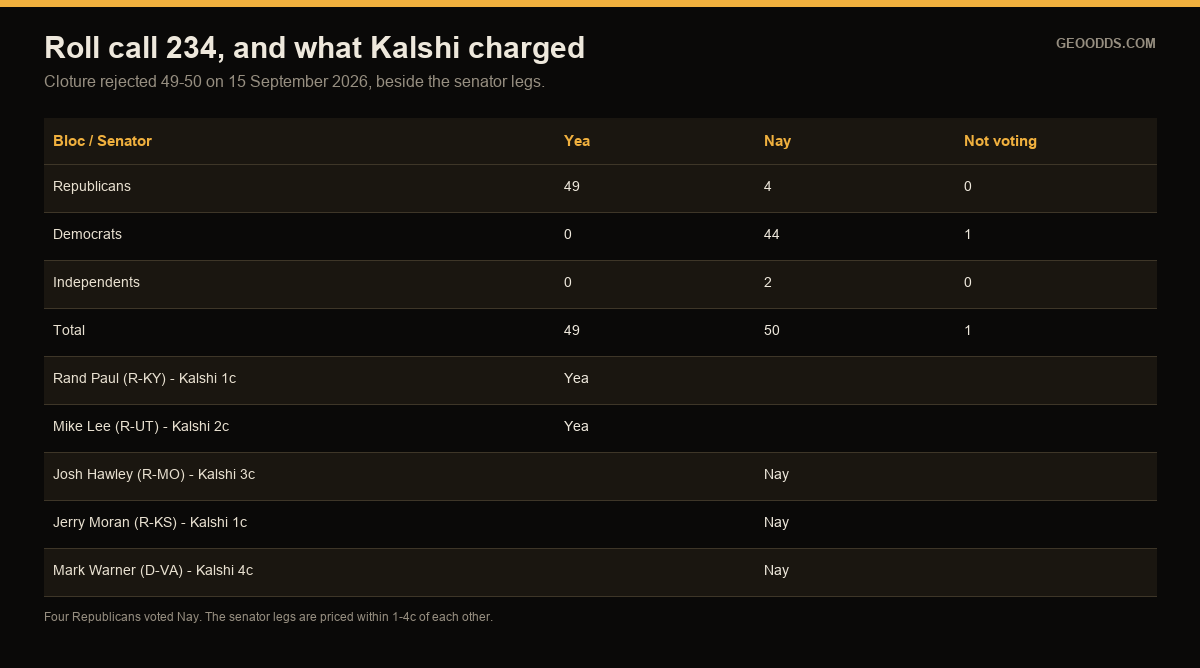
- The official roll call names four Republicans, not three. Roll call 234 rejected cloture 49–50 on 15 September. Collins, Hawley, Moran and Tillis voted Nay, and not one Democrat or independent voted Yea.
- 81.5¢ in February. The contract peaked on 20 February and has fallen roughly 148-fold since. Its single worst day was 16 September — 17.5¢ to 4.85¢, the morning after the vote.
- Kalshi’s senator markets do not discriminate between senators. Rand Paul voted Yea and prices at 1¢; Josh Hawley voted Nay and prices at 3¢. Neither price is about the senator.
Search the Clarity Act odds and page one will offer you 13%, 15%, 19%, 23%, 27%, 30%, 31%, 37%, 48% and 69%. Every one of those is a real Polymarket or Kalshi price from a different week of 2026, and the live number when we froze this page was 0.55¢.
The staleness is the small problem. The large one is that the two venues everybody quotes side by side are not asking the same question. Polymarket names a bill number. Kalshi does not. Read as one number they look like a disagreement worth trading; read as two contracts they are a coherent pair, and the difference between them is a price nobody has bothered to quote.
So we pulled both rulebooks: all nine rungs of Kalshi’s ladder, its eight vote-count rungs and twelve senator legs, a sweep of its public events feed to exhaustion — 116 pages, 23,199 open events — the full daily price history of the Polymarket contract, and the Senate’s own XML for the vote that broke it.
What comes back is a market that has fallen 148-fold since February on a bill that has already passed the House, a cloture roll call that the secondary coverage gets wrong by one senator, and a set of senator markets that price a Yea vote and a Nay vote within two cents of each other.
Where the Clarity Act odds stand tonight
Both exchanges carry a contract expiring at the end of 2026, and both are now priced in fractions of a cent. The spread between them is the story of this page, so it is worth seeing the two quotes side by side first.
| Polymarket | Kalshi | |
|---|---|---|
| Contract | H.R.3633 signed into law | A crypto bill becomes law |
| Deadline | 31 Dec 2026, 11:59pm ET | 1 Jan 2027, 15:00 UTC |
| Price (Yes) | 0.55¢ | 2.0¢ |
| Best bid / ask | 0.50¢ / 0.60¢ | 1.7¢ / 2.3¢ |
| Lifetime volume | $25,716,772 | 2,546,682 contracts |
| 24-hour volume | $481,921 | 0 contracts |
| Open since | 11 Jan 2026 | 4 Dec 2025 |
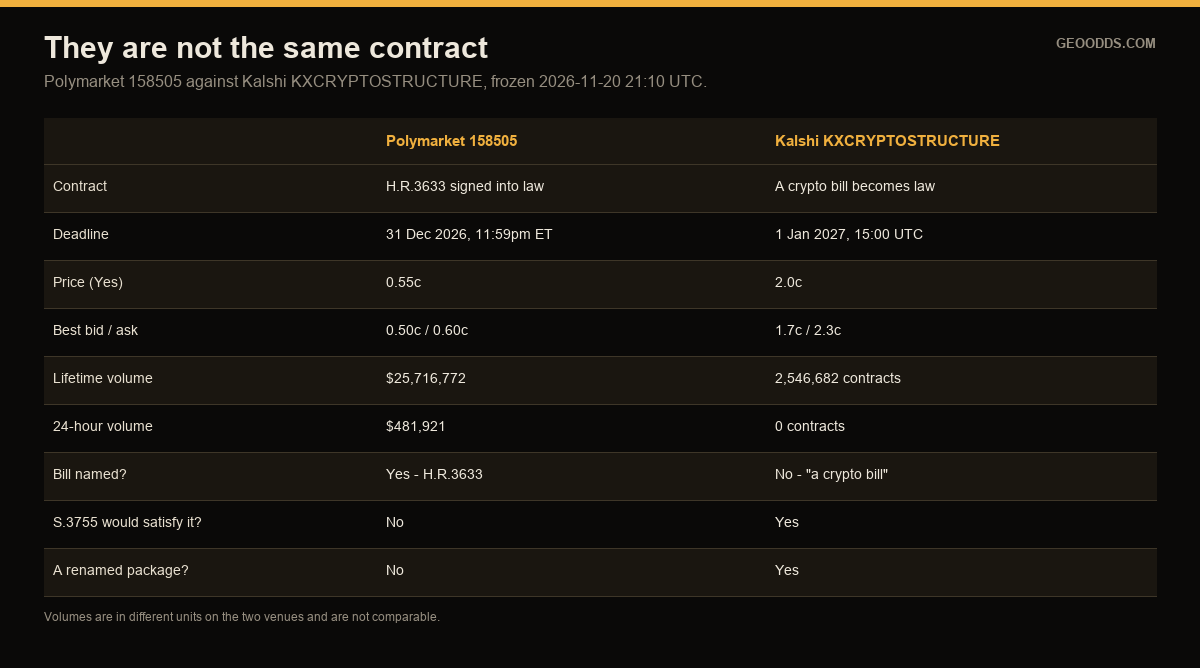
Two things stand out. The Polymarket contract is still busy — $481,921 changed hands in a day on a market quoted at half a cent — while the Kalshi rung that nominally asks the same thing has not traded at all in 24 hours. And Kalshi is quoted at roughly 3.6 times Polymarket’s price. That is not sloppiness on either side.
Polymarket and Kalshi are not pricing the same bill
Polymarket’s resolution text is specific to the point of citation. It resolves Yes if “the Digital Asset Market Clarity Act of 2025 (H.R.3633) is passed by both chambers of the U.S. Congress and signed into law by December 31, 2026, 11:59 PM ET”, and it names Congress.gov’s tracker for that bill as the primary source.
Kalshi’s rules never mention a bill number. Each rung reads: “If a crypto market structure bill has become law before [date], then the market resolves to Yes.” The event is titled Will the Clarity Act become law?, which is how the confusion starts, but the title is not the rulebook.
| Polymarket 158505 | Kalshi KXCRYPTOSTRUCTURE | |
|---|---|---|
| Bill named? | Yes — H.R.3633 | No — “a crypto bill” |
| S.3755 would satisfy it? | No | Yes |
| A renamed package? | No | Yes |
| Must pass both chambers | Stated explicitly | Implied by “become law” |
| Primary source | Congress.gov tracker | Not specified |
| Furthest deadline | 31 Dec 2026 | 1 Jan 2028 |
This matters because there is a second vehicle in play. The Senate Agriculture Committee advanced its own bill, the Digital Commodity Intermediaries Act (S.3755), on 29 January 2026 by 12 votes to 11 on party lines. Reconciling that with the Banking Committee’s text was always one of the remaining steps, and a reconciled product could easily carry a different number.
So Kalshi’s event is a strict superset of Polymarket’s: every world in which H.R.3633 becomes law is a world in which a crypto market structure bill becomes law, but not the reverse. Kalshi should therefore price higher, and the 1.45¢ difference is roughly what traders will pay for the non-CLARITY path — a renamed or reconciled bill clearing both chambers in the next 41 days. Treating the two quotes as rival estimates of one probability throws that information away.
What the official roll call actually records
The vote that reset this market has been described loosely enough that it is worth going to the Senate’s own file. Roll call 234 of the 119th Congress, second session, was taken at 02:19 PM on 15 September 2026 on a motion to invoke cloture on the motion to proceed to H.R.3633. It was rejected. Cloture needs 60.
| Bloc | Yea | Nay | Not voting |
|---|---|---|---|
| Republicans | 49 | 4 | 0 |
| Democrats | 0 | 44 | 1 |
| Independents | 0 | 2 | 0 |
| Total | 49 | 50 | 1 |
Two details in that table are not in the coverage. The first is the fourth Republican. DLA Piper’s note on the failure names Collins, Hawley and Moran; the roll call adds Thom Tillis of North Carolina. Both readings are arithmetically consistent with 49–50 and one absence, which is presumably how the discrepancy survived — but the Senate’s record lists four Nays with an R beside them.
The second is the zero. Not one Democrat or independent voted Yea. All 49 Yea votes were Republican. A bill that passed the House 294–134 in July 2025, with substantial Democratic support, could not attract a single Democratic vote to open debate fourteen months later. Reporting points to ethics provisions covering officials’ crypto holdings as the sticking point.
Tillis’s vote has a procedural edge worth noting: only a senator who voted on the prevailing side may move to reconsider, and with cloture rejected the prevailing side was Nay. His Nay therefore keeps that door open for his own caucus. Nothing has been scheduled through it.
The one-hour repricing this morning
The reason this page quotes 0.55¢ rather than the 1.7¢ it would have quoted yesterday is a single hour of trading that finished about nine hours before we froze these numbers.
| Hour (UTC) | Yes price | Move |
|---|---|---|
| 19 Nov 22:00 | 1.85¢ | — |
| 20 Nov 00:00 | 1.75¢ | −0.10¢ |
| 20 Nov 10:00 | 1.80¢ | +0.05¢ |
| 20 Nov 11:00 | 1.80¢ | flat |
| 20 Nov 12:00 | 0.45¢ | −1.35¢ |
| 20 Nov 15:00 | 0.35¢ | −0.10¢ |
| 20 Nov 17:00 | 0.35¢ | flat |
| 20 Nov 20:00 | 0.55¢ | +0.20¢ |
Between 11:00 and 12:00 UTC the contract lost three quarters of its remaining value, traded four hours at 0.45¢ and below, then recovered to 0.55¢ by the evening. We looked for a legislative trigger in that window and did not find one: no floor action, no cloture filing, no scheduling announcement.
That absence is the answer, not a gap in the research. With 41 days left on a contract needing a 60-vote motion nobody has filed, there is nothing to price but the calendar, and a book this thin can lose a cent and a half to one seller. The 24-hour movers board tracks these repricings across every market we follow.
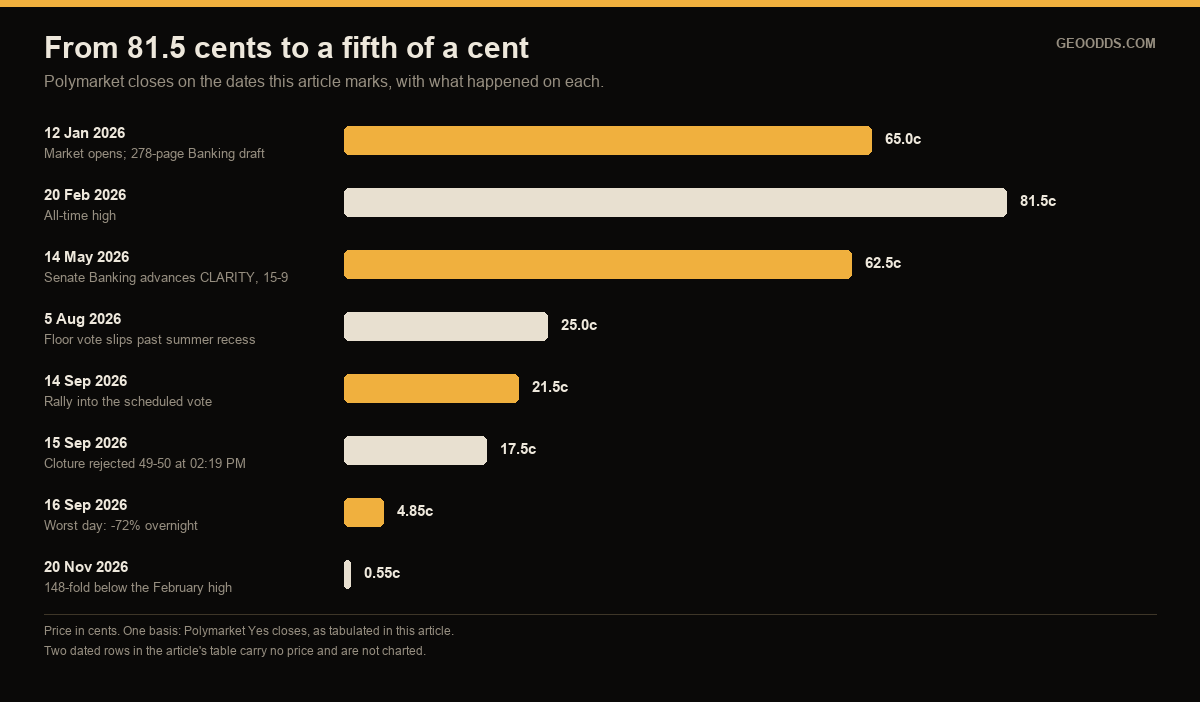
From 81.5¢ to 0.55¢: the year in nine dates
The contract opened at 65¢ on 12 January 2026, the day after it was created and the same week Senate Banking released a 278-page draft. It has 281 daily closes on file. Lining them up against the legislative calendar shows a market that tracked the committee process closely and then broke in one morning.
| Date | Price | What happened |
|---|---|---|
| 12 Jan 2026 | 65.0¢ | Market opens; 278-page Banking draft |
| 29 Jan 2026 | — | Senate Ag advances S.3755, 12–11 |
| 20 Feb 2026 | 81.5¢ | All-time high |
| 14 May 2026 | 62.5¢ | Senate Banking advances CLARITY, 15–9 |
| 1 Jun 2026 | — | Placed on calendar, General Orders 423 |
| 5 Aug 2026 | 25.0¢ | Floor vote slips past summer recess |
| 14 Sep 2026 | 21.5¢ | Rally into the scheduled vote |
| 15 Sep 2026 | 17.5¢ | Cloture rejected 49–50 at 02:19 PM |
| 16 Sep 2026 | 4.85¢ | Worst day: −72% overnight |
| 20 Nov 2026 | 0.55¢ | 148-fold below the February high |
The February peak is the part worth dwelling on. At 81.5¢ the market was nearly as confident as it ever got about a bill that, at that moment, had passed one chamber and had no Senate committee vote scheduled. It then spent four days giving back 30 points. The 14 September rally to 21.5¢ is the same error in miniature: traders bid the contract up into a vote that failed the next afternoon.
Kalshi’s ladder runs to 2028, and its middle rungs disagree
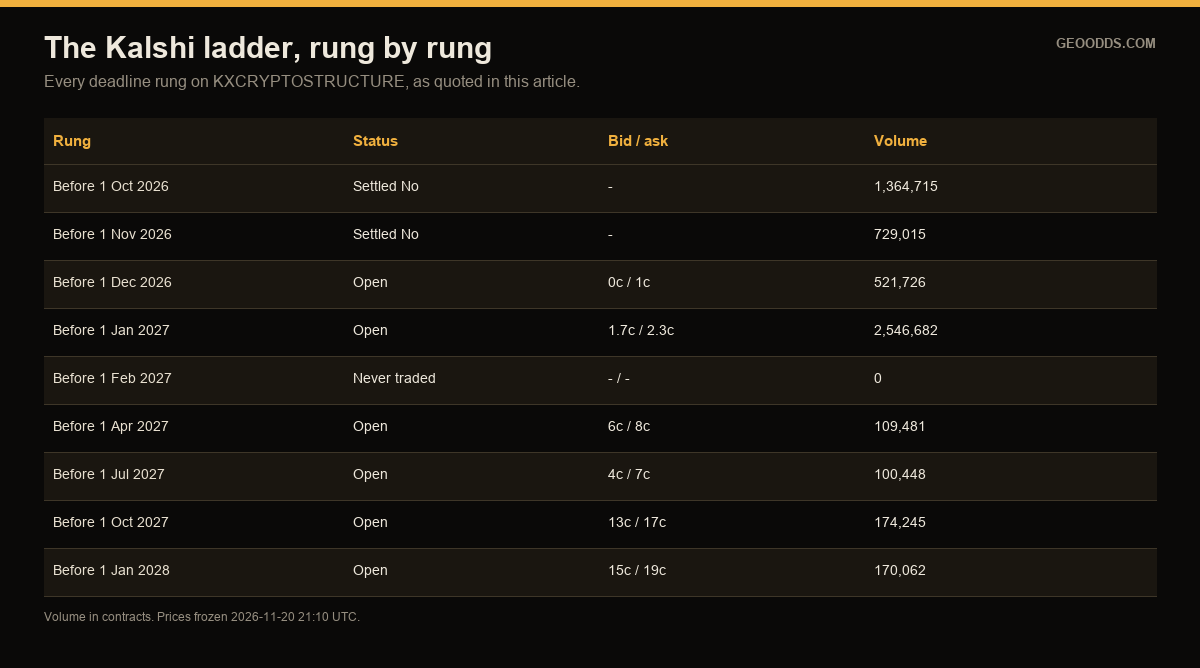
Polymarket runs one binary on this question. Kalshi runs a date ladder of nine, and because every rung shares the same generic rulebook, the ladder reads as a term structure for crypto market structure legislation rather than for one bill.
| Rung | Status | Bid / ask | Volume |
|---|---|---|---|
| Before 1 Oct 2026 | Settled No | — | 1,364,715 |
| Before 1 Nov 2026 | Settled No | — | 729,015 |
| Before 1 Dec 2026 | Open | 0¢ / 1¢ | 521,726 |
| Before 1 Jan 2027 | Open | 1.7¢ / 2.3¢ | 2,546,682 |
| Before 1 Feb 2027 | Never traded | — / — | 0 |
| Before 1 Apr 2027 | Open | 6¢ / 8¢ | 109,481 |
| Before 1 Jul 2027 | Open | 4¢ / 7¢ | 100,448 |
| Before 1 Oct 2027 | Open | 13¢ / 17¢ | 174,245 |
| Before 1 Jan 2028 | Open | 15¢ / 19¢ | 170,062 |
Two rungs have already reached their deadline and both settled No, between them carrying more than two million contracts. A third rung, “before 1 February 2027”, has been listed since December 2025 and has never traded once.
The defect is in the middle. The April 2027 rung bids 6¢ while the July 2027 rung — a strictly easier target, since any bill passing by April also passes by July — bids only 4¢, inverting the ladder’s logical order. It is not an arbitrage: July’s ask of 7¢ still sits above April’s bid of 6¢, so no risk-free trade exists, and both rungs last printed at 6¢. It is what a two-cent-wide book looks like when nobody is marking it.
Read from the far end, though, the ladder says something Polymarket cannot. At 15¢ to 19¢ for any crypto market structure bill before January 2028, these traders are not bearish on the policy. They are bearish on this bill, this Congress and this calendar — which is exactly what 0.55¢ against 18¢ encodes.
The senator markets are not about the senators
Kalshi also lists twelve contracts on whether individual senators will vote for a crypto market structure bill, and an eight-rung ladder on how many Yea votes such a bill would draw. Since we now have an actual roll call to check them against, they are a rare chance to test whether a named-individual market is doing what its title claims.
| Senator | Kalshi price | Vote on roll call 234 |
|---|---|---|
| Rand Paul (R-KY) | 1¢ | Yea |
| Mike Lee (R-UT) | 2¢ | Yea |
| Josh Hawley (R-MO) | 3¢ | Nay |
| Jerry Moran (R-KS) | 1¢ | Nay |
| Mark Warner (D-VA) | 4¢ | Nay |
| Kirsten Gillibrand (D-NY) | 1¢ | Nay |
| Ruben Gallego (D-AZ) | 1¢ | Nay |
| Angela Alsobrooks (D-MD) | 1¢ | Nay |
The ordering is backwards and the range is noise. Rand Paul and Mike Lee both voted to proceed and price at 1¢ and 2¢. Josh Hawley voted against and prices at 3¢, higher than either of them. Mark Warner, a Democrat who voted Nay, is the most expensive leg on the board at 4¢.
That is not a market misjudging senators. It is a market that is not about senators at all: every leg is a proxy for whether any qualifying floor vote happens before 2027, and once that probability is near zero, individual positions stop moving the price. Eleven of the twelve legs show zero 24-hour volume.
The vote-count ladder shows the same thing more starkly. “Above 68” Yea votes last printed at 4¢ while “Above 50” last printed at 1¢ — an impossibility, since every outcome above 68 is also above 50. With no 24-hour volume on any of the eight rungs, those last prices are old marks rather than quotes. The same pattern turned up on the conditional midterm boards in our Polymarket versus Kalshi midterms comparison: the boards people actually trade are coherent, and the ones they do not are not.
Every Clarity Act odds figure on page one is a mirror
We checked the pages currently ranking for this query. Not one of them quotes a price from this month, and the spread between them is wider than the entire remaining value of the contract.
One widely-linked market page carries four different numbers simultaneously: a live widget reading 1%, body copy saying 19% and then 23%, and an FAQ answering 27%. It is datelined 11 August and updated 20 August, and its own related-links rail includes stories from late September reporting the failed cloture vote that its text never mentions.
The closest thing to a real competitor is a 14 September comparison piece putting Polymarket at 30% and Kalshi at 37% — fair quotes on the day before the vote. But it describes Kalshi’s contract as resolving on “crypto market structure legislation” and Polymarket’s by its title, never notices that one names a bill and the other does not, and so reports a seven-point gap as a venue disagreement rather than the different-contract premium it is.
This is why we date every price to the minute and quote the rulebook before the number. Our methodology page sets out how we read prices, volume and resolution criteria.
What would have to happen in 41 days
H.R.3633 is further along than half a cent suggests. It passed the House 294–134 on 17 July 2025 and sits on the Senate Legislative Calendar under General Orders, Calendar No. 423. It needs no new committee work. For Polymarket to pay, the Senate would have to invoke cloture, pass the bill, and have the President sign it before 11:59pm ET on 31 December.
The binding constraint is the 60-vote motion to proceed. September produced 49 Yeas and no Democratic votes at all, so the path requires eleven senators from a caucus that unanimously declined to open debate ten weeks ago, during a lame-duck session, after that caucus won both chambers. Democrats took the House and the Senate in the November midterms — tallies differ on the exact margins — which lowers rather than raises the incentive to deliver this before January.
After that the question changes shape. Bills not enacted in the 119th Congress must be reintroduced in the 120th, so a January restart means new text, new committee votes and new numbering — at which point the Polymarket contract is unresolvable by construction and the Kalshi ladder is the only board still asking the question. That is why its 2028 rung trades at 18¢ while the named bill trades at half a cent. Both prices can be right. You can follow the live board on our Clarity Act odds page, which refreshes every ten minutes.
Related articles
- Polymarket vs Kalshi 2026 midterms odds: four books, one question
- 2026 election night odds: what the markets priced, hour by hour
- 2026 midterms odds: the Senate flip and the seat ladder
- 2026 House odds: the seat-count boards explained
- 2026 Senate swing-state odds: where the money went
- How GeoOdds reads prices, volume and resolution rules
New to prediction markets?
New traders get a $20 bonus
Deposit $10 on Polymarket and get a $20 trading bonus to put behind your first call.
See the live Clarity Act board on Polymarket →New Polymarket users only. Bonus is trading credit, expires 30 days after it lands, and terms are set by Polymarket — check the current offer at signup. 18+. Fee-free markets. GeoOdds earns a commission on signups through this link.
Frequently asked questions
What are the Clarity Act odds for 2026?
At 21:10 UTC on 20 November 2026, Polymarket pays 0.55¢ that H.R.3633 is signed into law by 31 December 2026 — a best bid of 0.50¢ against a best ask of 0.60¢. Kalshi pays 2.0¢ that a crypto market structure bill becomes law before 1 January 2027. The Polymarket contract has traded $25.72 million since January and $481,920 of that came in the last 24 hours.
Why do Polymarket and Kalshi show different Clarity Act odds?
Because they resolve on different events. Polymarket names the bill: the Digital Asset Market Clarity Act of 2025, H.R.3633 specifically, signed into law by 31 December. Every Kalshi rung resolves on “a crypto market structure bill” becoming law, which the Senate Agriculture Committee's S.3755 or a renamed package would satisfy. Kalshi's event is a superset of Polymarket's, so it should price higher, and the roughly 1.45¢ gap is the market's price for a crypto bill that is not CLARITY.
Did the Clarity Act fail in the Senate?
A cloture motion on it failed. Roll call 234 of the 119th Congress, taken at 02:19 PM on 15 September 2026, rejected cloture on the motion to proceed to H.R.3633 by 49 votes to 50, with one senator not voting. Invoking cloture needs 60. The bill itself was never voted on for passage, and it remains on the Senate Legislative Calendar under General Orders, Calendar No. 423.
Which Republicans voted against the Clarity Act?
Four: Susan Collins of Maine, Josh Hawley of Missouri, Jerry Moran of Kansas and Thom Tillis of North Carolina. The other 49 Republicans voted Yea. Some secondary coverage names only three and omits Tillis — the Senate's own roll-call record lists four. Not one Democrat or independent voted Yea, so the 49 Yea votes were entirely Republican.
Can the Clarity Act still become law in 2026?
Only through the lame-duck session, and the market prices that at about half a cent. H.R.3633 has already passed the House, so it needs Senate passage and a signature — but the motion to proceed still needs 60 votes, and the September vote produced zero Democratic Yeas. Thom Tillis voted on the prevailing side, which is what keeps a motion to reconsider procedurally available, though nothing has been scheduled.
What happens to the Clarity Act in the next Congress?
Bills not enacted in the 119th Congress die with it and must be reintroduced in the 120th, which convenes in January 2027. Democrats won both chambers in the November 2026 midterms, so the committee gavels change hands, while Senate Republicans retain more than enough seats to filibuster. Kalshi's furthest rung prices any crypto market structure bill becoming law before January 2028 at 15¢ to 19¢.
Is 0.55¢ a fair price on the Clarity Act?
We will not call it mispriced from a single number, and the structure argues against reading it as pessimism about crypto legislation generally. What 0.55¢ buys is narrow: one named bill, H.R.3633, signed by one president, inside 41 days, through a cloture vote that has already failed once with no votes to spare from the other party. Kalshi's 18¢ on any such bill by January 2028 is the same traders being considerably less bearish about the policy than about the calendar.
Sources: prices, volume, creation dates and the full resolution text from the Polymarket Gamma and CLOB public APIs (event 158505, plus 281 daily closes and today’s hourly closes for market 1163699) and from the Kalshi public markets API (all nine KXCRYPTOSTRUCTURE rungs, the eight KXVOTECLARITY rungs and the twelve KXSVOTECLARITY senator legs), all read at 20 November 2026, 21:10 UTC; the cloture tally and every per-senator vote from Senate roll call vote 234 of the 119th Congress; the legislative timeline from Latham & Watkins’ US crypto policy tracker and DLA Piper’s note on the failed vote; and the bill text and status from Congress.gov’s H.R.3633 tracker, which is the Polymarket contract’s own named resolution source. Prices move; the figures above are a frozen snapshot and nothing here is financial, legal or investment advice.