
2026 Senate Odds: Oil Under $80 Costs 19 Points
Published 26 October 2026 · Prices frozen 26 October 2026, 16:20 UTC
Key takeaways
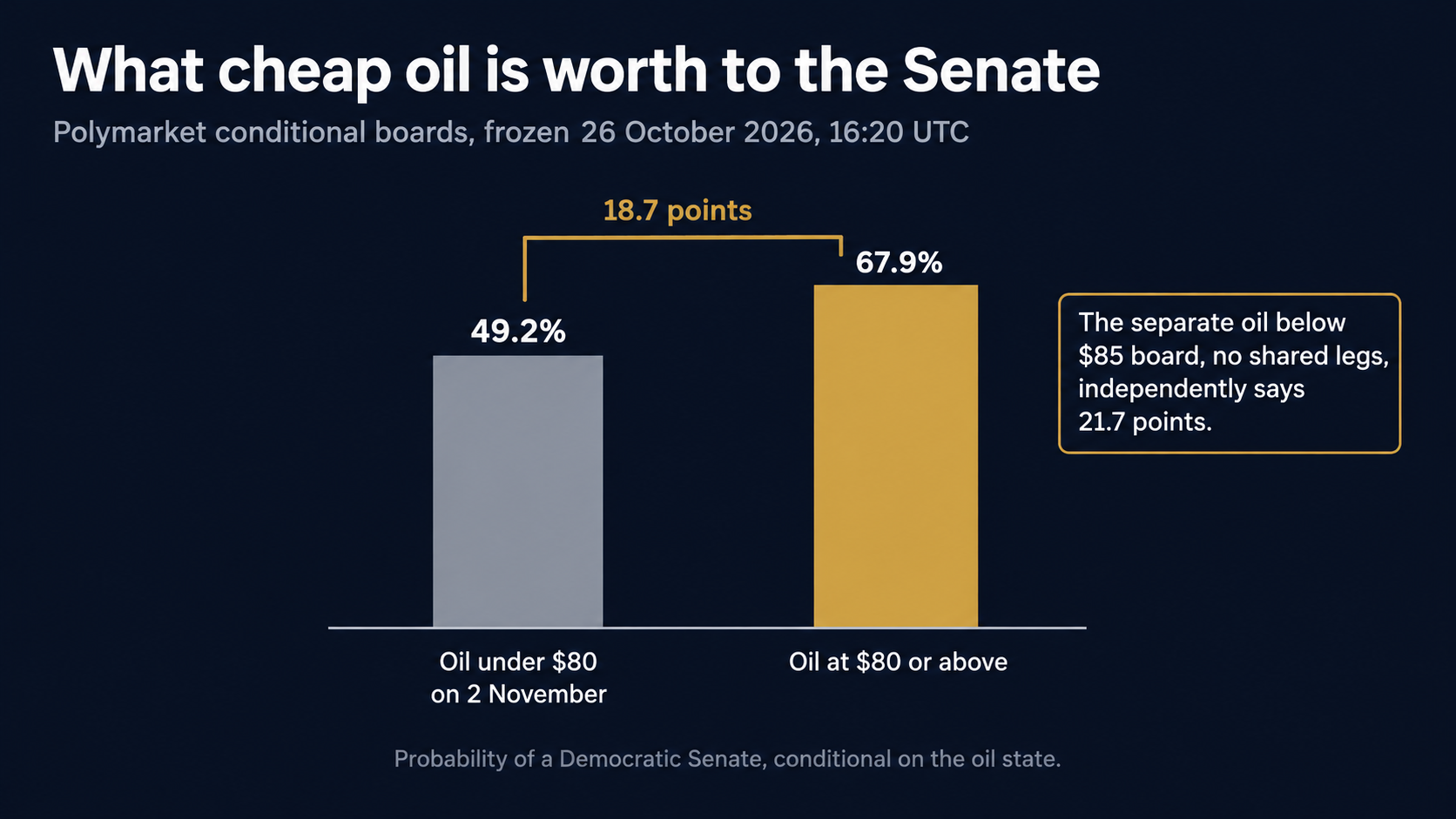
- Conditional on oil closing under $80 on 2 November, Polymarket puts the Democratic Senate at 49.2%. Conditional on $80 or above, 67.9%. An 18.7-point swing, and the separate $85 board independently says 21.7. Cheaper oil is the largest single thing these markets price into the Senate.
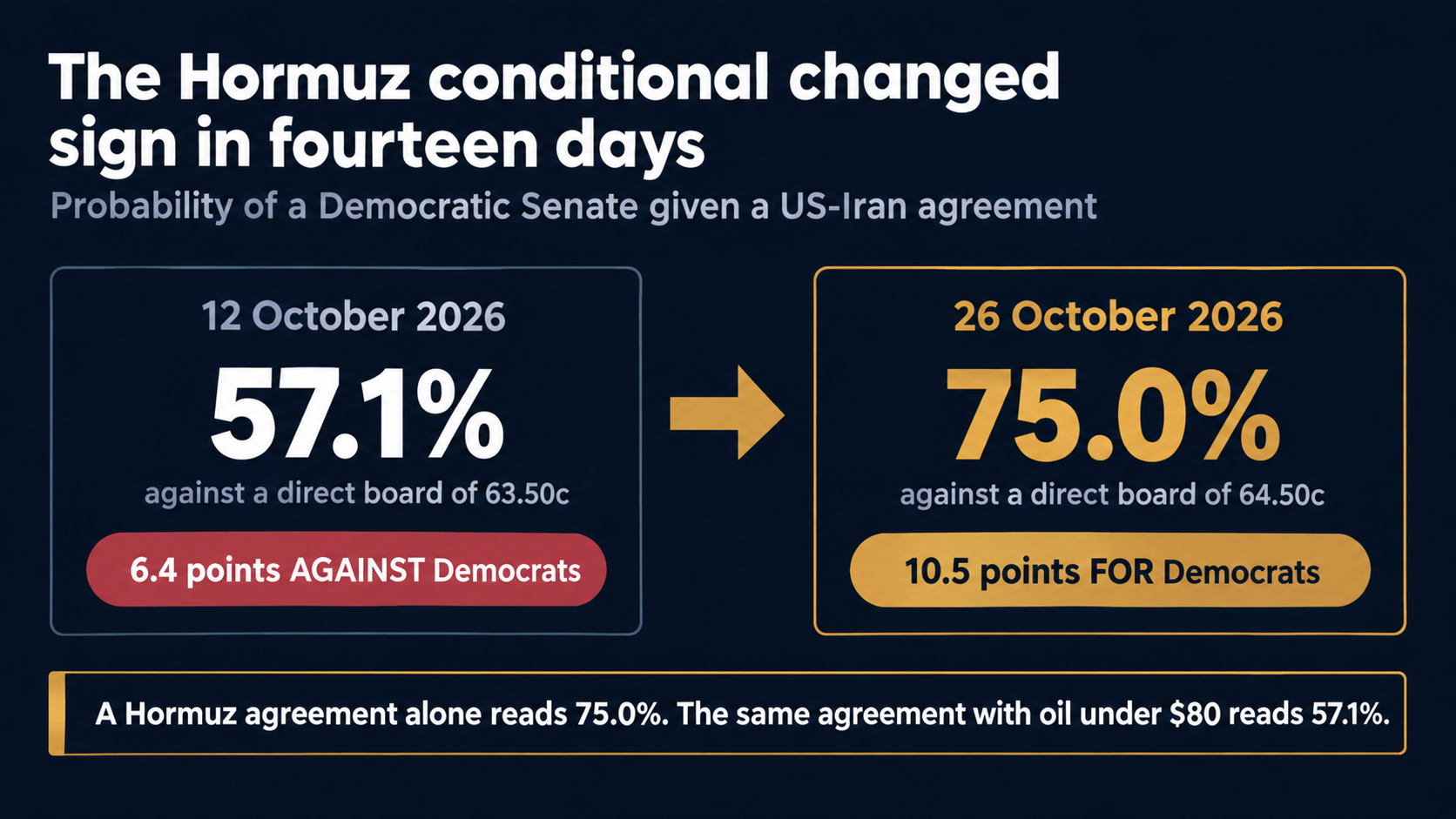
- The Hormuz leg has changed sign in fourteen days. On 12 October a US–Iran deal was priced 6.4 points against Democrats; tonight it is 10.5 points for them, with the conditional up from 57.1% to 75.0%.
- The deal and the cheap oil it would cause point opposite ways. A Hormuz agreement alone reads 75.0% Democratic; the same agreement with oil under $80 reads 57.1%. The diplomacy is not what the market thinks moves the chamber. The barrel is.
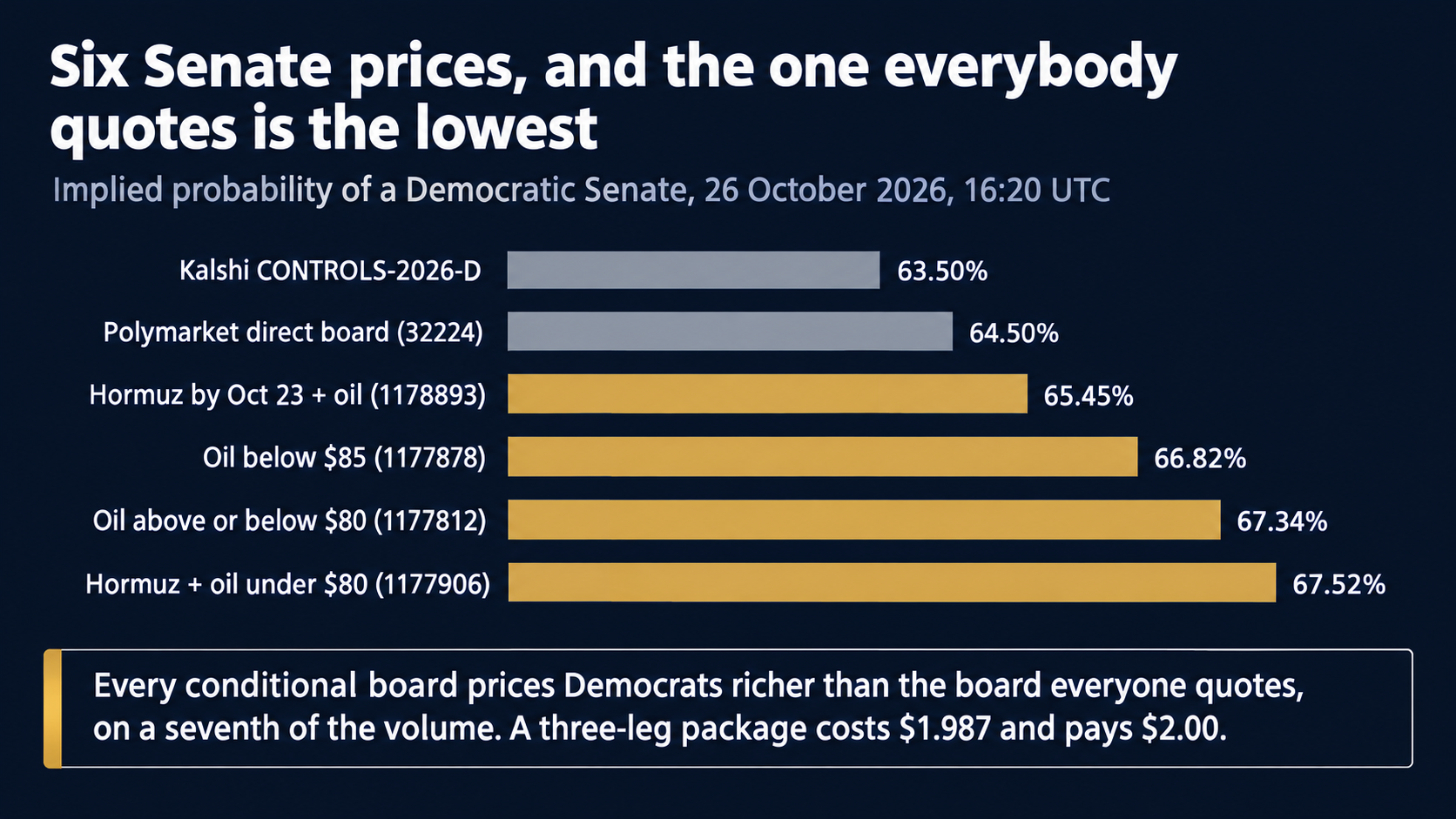
- All five conditional boards price Democrats richer than the board everyone quotes. They imply 65.5% to 67.5% against the direct market’s 64.5¢, on a seventh of the volume. The gap survives the spread: a three-leg package costs $1.987 and pays exactly $2.00.
- The branch carrying the headline is a 3% branch. Oil under $80 needs ICE WTI to fall 20.8% in five trading days from about $101, and the board prices that at 3.15¢. The levels are a tail; the ratio inside it is not.
Every tracker quoting 2026 Senate odds quotes one number, and Polymarket is selling six. Eight days out from 3 November the direct board pays 64.5¢ on a Democratic Senate, and five separate conditional boards — three tied to the price of oil, two to a US–Iran deal over the Strait of Hormuz — price the same chamber between 65.5% and 67.5%. They also do something the direct board cannot: they say what the market thinks each of those events is worth.
That matters because the answer is large. A twenty-point conditional swing is bigger than any individual Senate race on either exchange, bigger than the gap between the two venues, and bigger than the spread between the public models. If it is right, the most important number for the Senate in the next eight days is not a poll. It is a barrel.
We pulled every leg of all five conditional boards and the direct market in one pass, divided each branch out by hand to recover the conditional probabilities the leg prices hide, bounded every ratio at the bid and at the ask, walked the fourteen days of CLOB history since the boards opened, and checked the implied oil distribution against Kalshi’s own WTI ladder. All prices are frozen at 26 October 2026, 16:20 UTC; the live boards are linked throughout.
Where the 2026 Senate odds stand tonight
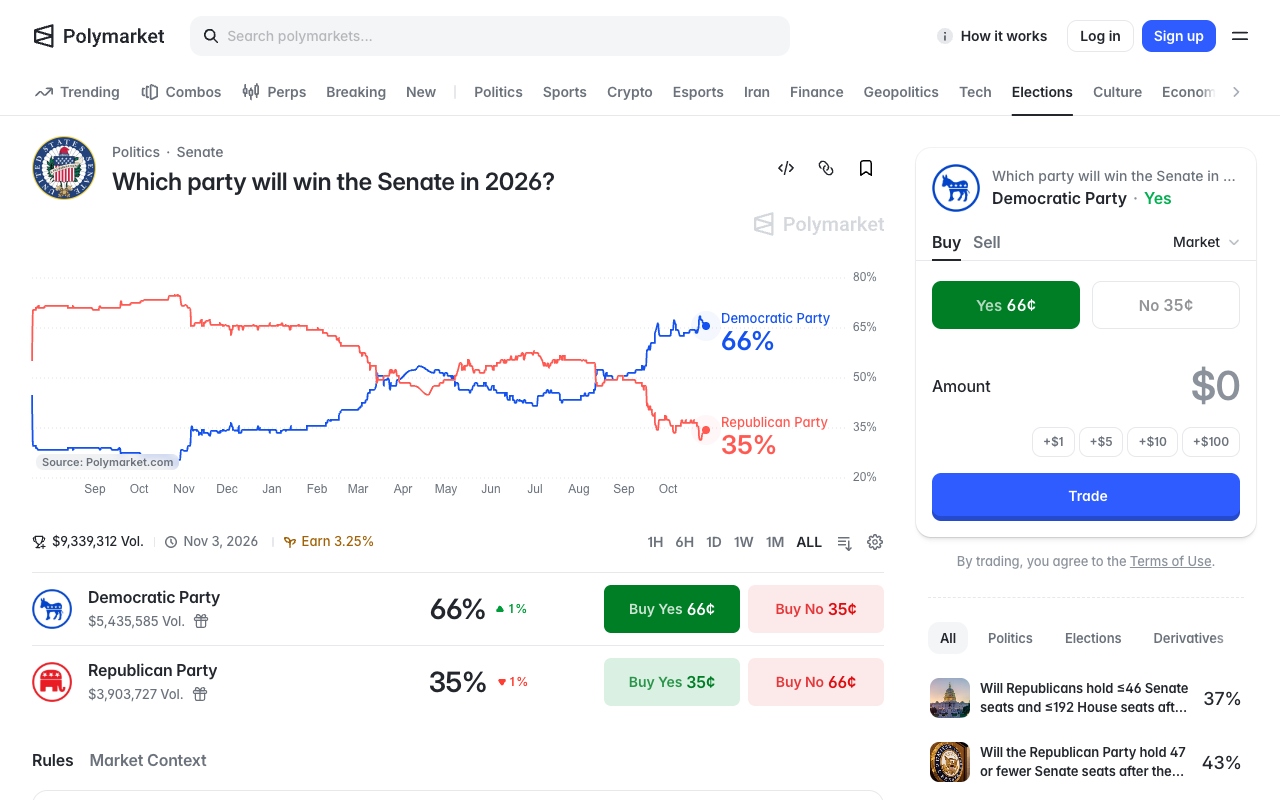
Start with the market that gets quoted. Polymarket’s Which party will win the Senate in 2026? board is a clean two-sided contract, it has traded since July 2025, and at $9.28m it is the deepest Senate market on either venue. Kalshi’s pair of control contracts sit a point below it. Then there are the five boards nobody quotes, and every one of them disagrees.
| Contract | Implied D | Book | Volume |
|---|---|---|---|
| Polymarket direct (32224) | 64.50% | 100.00¢ | $9.28m |
| Kalshi CONTROLS-2026-D | 63.50% | 100.00¢ | 8.30m |
| Oil above/below $80 (1177812) | 67.34% | 99.50¢ | $774,628 |
| Oil below $85 (1177878) | 66.82% | 100.20¢ | $1.20m |
| Hormuz + oil < $80 (1177906) | 67.52% | 99.75¢ | $198,015 |
| Hormuz by Oct 23 + oil (1178893) | 65.45% | 99.70¢ | $398,868 |
| Hormuz Agreement (1172100) | n/a | 100.05¢ | $1.57m |
The last row is the odd one out and it is worth saying why now. The Hormuz-only board splits the deal branch into Republican and Democratic Senate legs but leaves the no-deal branch whole, as a single 93.05¢ outcome. So it publishes a conditional probability and withholds an unconditional one, which is the reverse of every other board here.
A leg price is not a conditional probability
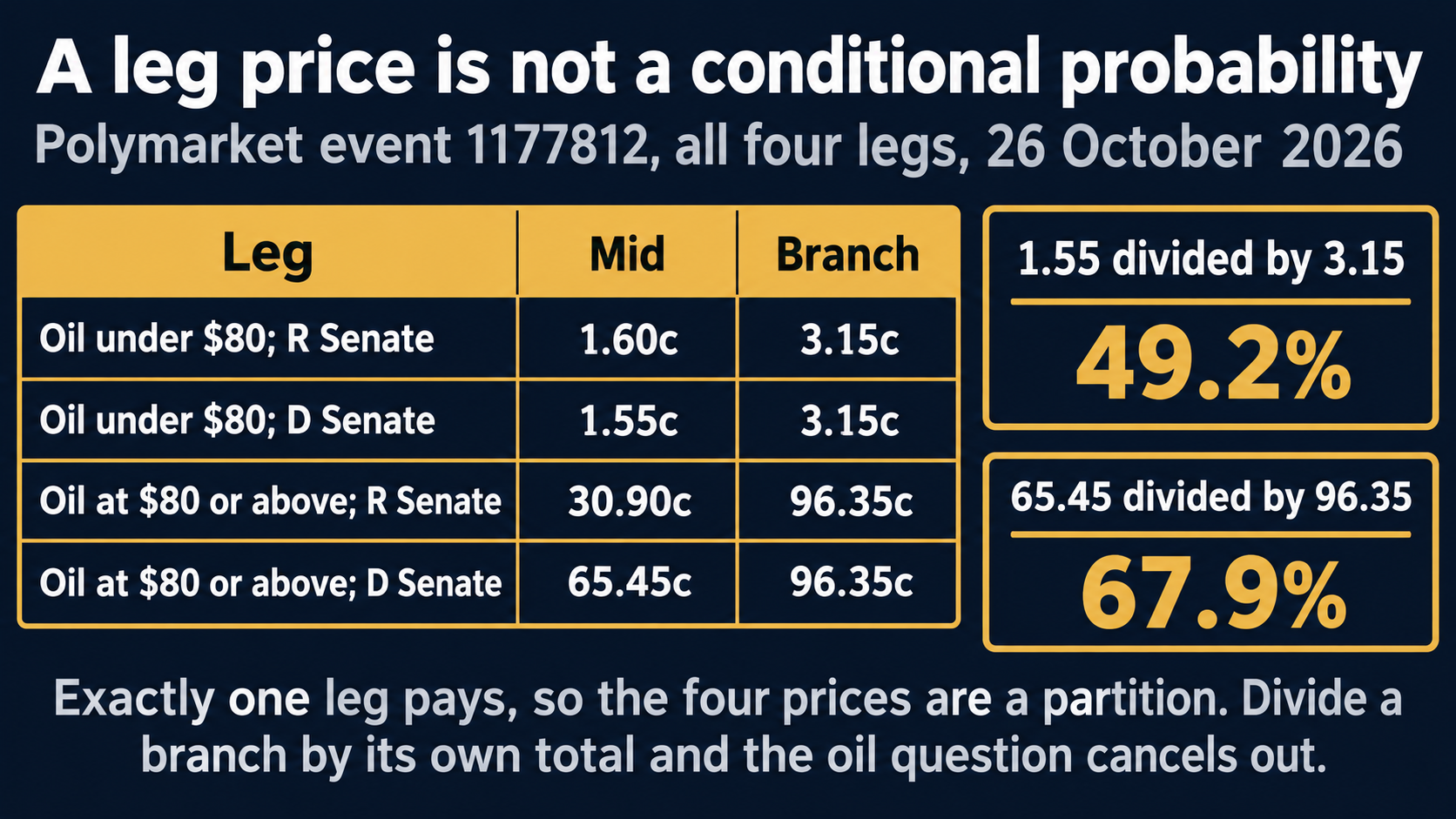
This is the mistake worth getting out of the way, because it is already in print. A published macro note last week reported that the Senate contract tied to oil above $85 trades at 65.1%. That is a joint price — the probability oil stays above $85 and Democrats win — and reading it as a Senate probability throws away the whole point of a conditional board.
The oil above or below $80 board has four legs covering every pairing of two oil states with two Senate states. Exactly one pays, so the four prices are a partition and the arithmetic is forced: divide a branch by its own total and the oil question cancels out.
| Leg | Mid | Bid/ask | Branch | Volume |
|---|---|---|---|---|
| Oil < $80; R Senate | 1.60¢ | 1.4/1.8 | 3.15¢ | $259,131 |
| Oil < $80; D Senate | 1.55¢ | 1.4/1.7 | 3.15¢ | $273,166 |
| Oil ≥ $80; R Senate | 30.90¢ | 30.5/31.3 | 96.35¢ | $130,539 |
| Oil ≥ $80; D Senate | 65.45¢ | 64.9/66.0 | 96.35¢ | $111,792 |
So the board is saying two things at once. It prices oil under $80 at 3.15¢, and it prices the Senate given oil under $80 at 1.55/3.15, or 49.2%. Against the other branch, 65.45/96.35, or 67.9%. Those are the numbers the leg prices hide, and they are the article.
Oil under $80 is worth 19 points to Republicans
Run the same division on the oil below $85 board and a second, independently traded book gives the same answer with a different threshold. That is the part that makes this worth publishing: two boards, $1.97m between them, no shared legs, and they agree that the direction and rough size of the effect is twenty points.
The obvious objection is that the cheap-oil legs are tiny, so the ratio is noise. It is not, and the bid/ask columns above are why. Because both legs of a branch are quoted at a similar level, the ratio is far better behaved than either price: at every bid the $80 board says 50.0%, at every ask 48.6%.
| Board | P(D | cheap) | P(D | dear) | Gap | At bids / asks |
|---|---|---|---|---|
| Oil < $80 (1177812) | 49.2% | 67.9% | 18.7 pts | 50.0% / 48.6% |
| Oil < $85 (1177878) | 46.5% | 68.2% | 21.7 pts | 46.7% / 46.3% |
| Hormuz + oil < $80 (1177906) | 57.1% | 67.9% | 10.8 pts | — |
Nineteen to twenty-two points is a very large number in this context. Over the seven days to 23 October our governor-race piece measured the biggest single state move of the cycle at fifteen points. The market is saying a week of cheap crude would do more to the Senate than the worst week any individual candidate has had.
The branch doing the work is a 3% branch
Now the honest caveat, because the conditional is a real price attached to an outcome the same market calls very unlikely. ICE WTI is trading around $101 and the contract settles on a single closing print on 2 November. Getting under $80 from there is a 20.8% fall in five trading sessions.
Kalshi cannot check this, which is worth stating plainly: its KXWTI ladder settles daily, and both of its monthly oil series list zero open markets. So the 2 November oil condition has no cross-exchange price at all. What Kalshi does give is an independent read on the level, and its 27 October rungs put the median around $102.
| Threshold | Polymarket | Implied fall | Kalshi 27 Oct | Above |
|---|---|---|---|---|
| Under $80 on 2 Nov | 3.15% | −20.8% | not listed | — |
| Under $85 on 2 Nov | 6.35% | −15.9% | not listed | — |
| Above $99.99 | — | — | 0.87/0.89 | 88% |
| Above $101.99 | — | — | 0.61/0.63 | 62% |
| Above $103.99 | — | — | 0.29/0.31 | 30% |
| Above $105.99 | — | — | 0.12/0.13 | 12.5% |
Two readings survive this and they are not the same. Either the conditional is a genuine statement about how voters would react to a collapse in energy prices, in which case it is the most interesting number on the board and almost nobody will collect on it. Or it is what a handful of traders will pay for a 3¢ lottery ticket, in which case the ratio is still well bounded but means less than it looks. The evidence for the first reading is that the second board, at a different threshold, independently agrees.
The Hormuz conditional flipped sign in fourteen days
On 12 October this site published a House and Senate piece that read the then-new Hormuz Agreement board as pricing a US–Iran deal at 57.4¢ Democratic against a 63.5¢ direct market, and called it the first identifiable event in the cycle the market read as helping Republicans. That number has since turned over completely.
| Date | Deal R / D | P(deal) | P(D | deal) | Direct | Delta |
|---|---|---|---|---|---|
| 12 Oct | 7.40 / 9.85 | 17.25¢ | 57.1% | 63.50¢ | −6.4 |
| 14 Oct | 6.85 / 8.70 | 15.55¢ | 55.9% | 63.50¢ | −7.6 |
| 16 Oct | 1.95 / 2.95 | 4.90¢ | 60.2% | 64.50¢ | −4.3 |
| 17 Oct | 2.25 / 2.75 | 5.00¢ | 55.0% | 64.50¢ | −9.5 |
| 19 Oct | 3.65 / 4.75 | 8.40¢ | 56.5% | 64.50¢ | −8.0 |
| 21 Oct | 3.55 / 7.65 | 11.20¢ | 68.3% | 63.50¢ | +4.8 |
| 23 Oct | 3.15 / 7.80 | 10.95¢ | 71.2% | 68.50¢ | +2.7 |
| 24 Oct | 1.75 / 5.60 | 7.35¢ | 76.2% | 67.50¢ | +8.7 |
| 26 Oct | 1.75 / 5.25 | 7.00¢ | 75.0% | 64.50¢ | +10.5 |
The crossover is 20–21 October and it is not a thin-book artefact: the Democratic deal leg roughly doubled, from 3.65¢ to 7.65¢, while the Republican one barely moved. At the same time the deal itself was being written off, falling from 17.25¢ to 7.00¢ as the strait crisis passed eight months with the waterway still restricted.
The deal and the oil it would cause disagree
Put the two findings next to each other and they appear to collide. A Hormuz agreement reads 75.0% Democratic. Cheap oil reads 49.2%. A deal reopening the strait is the most plausible route to cheap oil there is, so how can one be good for Democrats and the other bad?
The fifth board answers it. The Hormuz-plus-oil board pays only if both happen, and conditional on both it puts Democrats at 57.1% — 17.9 points below the deal on its own. So the market is not contradicting itself. It is separating a deal that gets announced from a deal that reaches the pump inside a week, and pricing only the second as Republican-friendly.
That is a coherent and fairly sophisticated position: an announcement eight days before polling is a headline, while a 20% fall in crude is a price voters actually pay. It also explains the 20–21 October crossover, which came as traders cut the odds of oil under $80 from 5.20¢ to 3.15¢ — the cheap-oil path closing off, leaving the announcement by itself.
Five boards, five Senate prices, 1.3¢ on the table
There is one more thing the partition makes testable. Each four-leg board covers every outcome, so adding its two Democratic legs and dividing by the book has to return the plain Senate probability. In a coherent market all five answers would match the direct board. None of them does, and all four two-way boards miss in the same direction.
| Board | Implied D | vs direct | Volume |
|---|---|---|---|
| Oil above/below $80 (1177812) | 67.34% | +2.84 | $774,628 |
| Hormuz + oil < $80 (1177906) | 67.52% | +3.02 | $198,015 |
| Oil below $85 (1177878) | 66.82% | +2.32 | $1.20m |
| Hormuz by Oct 23 + oil (1178893) | 65.45% | +0.95 | $398,868 |
| Polymarket direct (32224) | 64.50% | — | $9.28m |
The fourth row deserves a note of its own, because it is the cleanest accidental experiment in the group. Its agreement deadline was 23 October, nothing was announced, and both agreement legs collapsed to 0.05¢. What is left is a pure two-sided Senate book quoting 34.40 and 65.20 — a second Senate market created by a condition failing, trading a point richer for Democrats than the one everyone reads.
A 2.84-point mid-to-mid gap on the $80 board is wide enough to ask whether it is executable, so we checked at the quotes rather than the mids. Taking the NO side of both Democratic legs costs 98.6¢ and 35.1¢, and the Democratic side of the direct board costs 65¢. Those three positions pay exactly $2.00 in every state of the world and cost $1.987, which locks 1.3¢ — about 0.65% over eight days, or the wrong side of 2% a month for tying up nearly $2 of collateral. That is most likely the whole explanation for why a visible inconsistency across $4.14m of boards has sat open for a fortnight. Nothing here is financial or betting advice.
What would actually move this before 3 November
The oil print on 2 November is the one date that matters to four of these five boards, and it is a single close rather than an average, so a one-session move decides them. Below $85 currently needs 15.9% and the market pays 6.35¢ for it.
On the diplomatic side the thing to watch is not the talks but the deadline. The Hormuz board resolves to no-deal immediately on 2 November, and the separate ceasefire-through-the-midterms board is at 82.5¢, so the market expects quiet rather than resolution.
And if you only take one number from this page, take the one the direct board does not print. Two independent books, quoted at bid and at ask, say the Senate is a coin flip in a cheap-oil world and a two-thirds Democratic hold in a dear-oil one. Eight days out, that is a bigger stated effect than anything else either exchange is pricing — and it sits on five boards carrying a seventh of the volume of the one number everyone quotes.
Related analysis
- Which party will win the Senate in 2026? — the live board
- 2026 midterms odds: the Senate flipped in 30 days
- 2026 House odds: markets 90¢, models 76-93%
- Strait of Hormuz reopening odds — the oil side of this trade
- 2026 governor race odds: 36 boards vs one ladder
- Balance of Power 2026 — both chambers in one live book
- 2026 midterms hub — every Senate and governor race we track
New to prediction markets?
New traders get a $20 bonus
Deposit $10 on Polymarket and get a $20 trading bonus to put behind your first call.
See the conditional Senate boards on Polymarket →New Polymarket users only. Bonus is trading credit, expires 30 days after it lands, and terms are set by Polymarket — check the current offer at signup. 18+. Fee-free markets. GeoOdds earns a commission on signups through this link.
Frequently asked questions
What are the 2026 Senate odds right now?
On 26 October 2026 Polymarket's direct board prices a Democratic Senate at 64.5¢ against 35.5¢ for Republicans, and the two sides sum to exactly 100.0¢. Kalshi's CONTROLS-2026-D sits on a 63¢ bid and a 64¢ ask, a 63.5¢ midpoint, with the Republican side at 36.5¢. The two exchanges are one point apart. Polymarket's five conditional Senate boards all price Democrats higher, between 65.5% and 67.5%.
What is a conditional prediction market?
A board that pays out on a combination of two things rather than one. Polymarket's oil board has four legs covering every pairing of {oil below $80, oil $80 or above} with {Republican Senate, Democratic Senate}, so exactly one leg pays. Because the four legs partition every outcome, you can divide one branch by itself to recover a conditional probability the direct Senate board does not publish.
Does the oil price affect the 2026 Senate odds?
Polymarket's traders price it as the single largest identifiable factor. Conditional on ICE WTI closing below $80 on 2 November, the board puts Democrats at 49.2%; conditional on $80 or above, 67.9%. The $85 board says 46.5% against 68.2%. Two independently traded boards therefore agree that cheaper oil is worth 19 to 22 points to Republicans, which is roughly three times what any single state race is worth.
Which oil price do these markets settle on?
The Close price for the Active Month of ICE Futures Europe WTI Crude Futures, as published by Pyth under the symbol CLL, for the 2 November 2026 trading day. It is not NYMEX WTI and it is not Brent, and it is a single day's closing print rather than a campaign average. If the active month does not trade that session, the most recent prior trading day is used.
What is the Hormuz Agreement market?
A three-leg Polymarket board that pays on a US-Iran diplomatic agreement over Strait of Hormuz shipping traffic being announced by 2 November 2026, paired with the Senate result. It resolves to "No Hormuz Agreement" immediately if nothing is announced by then. Tonight it prices the agreement itself at 7.0¢, down from 17.25¢ on 12 October, and conditional on a deal it puts Democrats at 75.0%.
Why do Polymarket's five Senate boards give five different answers?
Because almost nobody trades the Senate dimension of a conditional board. The direct board carries $9.28m of volume; the five conditional boards carry $4.14m between them and most of that sits on the oil leg, not the party leg. Add the two Democratic legs of any conditional board and you get 65.5% to 67.5% against the direct board's 64.5%. All five are richer for Democrats than the market everyone quotes.
Can you arbitrage the gap between these boards?
At tonight's executable prices the gap is real but thin. Buying the NO side of both Democratic legs on the $80 board (98.6¢ and 35.1¢) alongside the Democratic side of the direct board (65¢) costs $1.987 and pays exactly $2.00 in every outcome, locking 1.3¢ for eight days — about 0.65% on capital. That capital cost is most likely why a 2.8-point mid-to-mid gap has sat open for two weeks. Nothing here is betting advice.
Sources: the Polymarket Gamma and CLOB public APIs (event 32224 plus conditional events 1172100, 1177812, 1177878, 1177906 and 1178893) and the Kalshi markets API (CONTROLS-2026-D, CONTROLS-2026-R and the KXWTI-26OCT2714 ladder), all read at 26 October 2026, 16:20 UTC. Resolution criteria are quoted from the descriptions Gamma publishes; note that events 1177906 and 1178893 publish no terms in that field at all, only a link to a PDF, so their leg titles are the only machine-readable statement of their terms. The oil component settles on the Active Month close of ICE Futures Europe WTI Crude Futures as published by Pyth under the symbol CLL. The closure of the strait since 28 February 2026, the 17 June Islamabad Memorandum and the 8 July breakdown of the interim truce are as described here. Our methodology page explains how we read the two venues. Prices here are a frozen snapshot; the live numbers are on the market pages. Nothing here is financial or betting advice.