
NATO Russia Clash Odds 2026: The Shoot-Downs Don’t Count
Published 16 November 2026 · Prices frozen 16 November 2026, 16:17 UTC
Key takeaways
- 318 days open, nothing counted yet. The 31 December contract’s qualifying window opened on 2 January 2026 and is still unresolved, so by this market’s own resolver not one event this year has been a NATO–Russia military clash. It trades at 11.5¢.
- Five Russian drones destroyed by NATO fighters, none of them qualifying — a Romanian F-16 on 24 July, a Spanish F-18 near Galați on 16 August, an F-16’s cannon on a naval drone 80nm off Constanța on 20 August, and two Geran-4s downed four minutes apart on 17 October. The rungs covering them settled No.
- The rulebook excludes the war’s actual shape. Airspace violations, warning shots, cyberattacks and collisions are all excluded by name, as is intercepting a Shahed-type munition aimed at a third party. Shooting down a reconnaissance UAV would qualify; shooting down an attack drone bound for Ukraine does not.
- 25¢ to 10.5¢ in a single day. On 23 October the Khoryv sank 13nm off Constanța and Romania’s president attributed it to a Russian drone. The new 30 November rung opened at 25¢ and closed the next day at 10.5¢, with no new qualifying incident reported in between.
- Kalshi lists nothing to compare it with — no NATO–Russia conflict contract across 19,290 open events. Its entire Russia book is GDP, interest rates, unemployment and diesel imports.
Search the NATO Russia clash odds and you will be told the market sits somewhere between 15.5% and 23.5%. Every one of those figures is a mirror of a Polymarket price taken weeks or months ago, and the live number when we froze this page was 11.5¢.
The staleness is the small problem. The large one is that none of those pages reads the contract. A “military clash” here is not a mood or a headline count — it is a defined term with four written exclusions, and those exclusions happen to cover almost exactly the kind of incident that has filled the last twelve months.
So we read the rulebook against the record. We pulled all eight rungs of the board, the full daily price history of both open ones, and then swept Kalshi’s entire public events feed — 97 pages, 19,290 open events — looking for a second opinion.
What comes back is a board that has settled No six times, including once this morning, across a year in which NATO-member fighters destroyed at least five Russian drones and a think tank counted seventeen attacks on the alliance’s frontline states inside a single month. Both things are true, and the rulebook is the reason.

Where the NATO Russia clash odds stand today
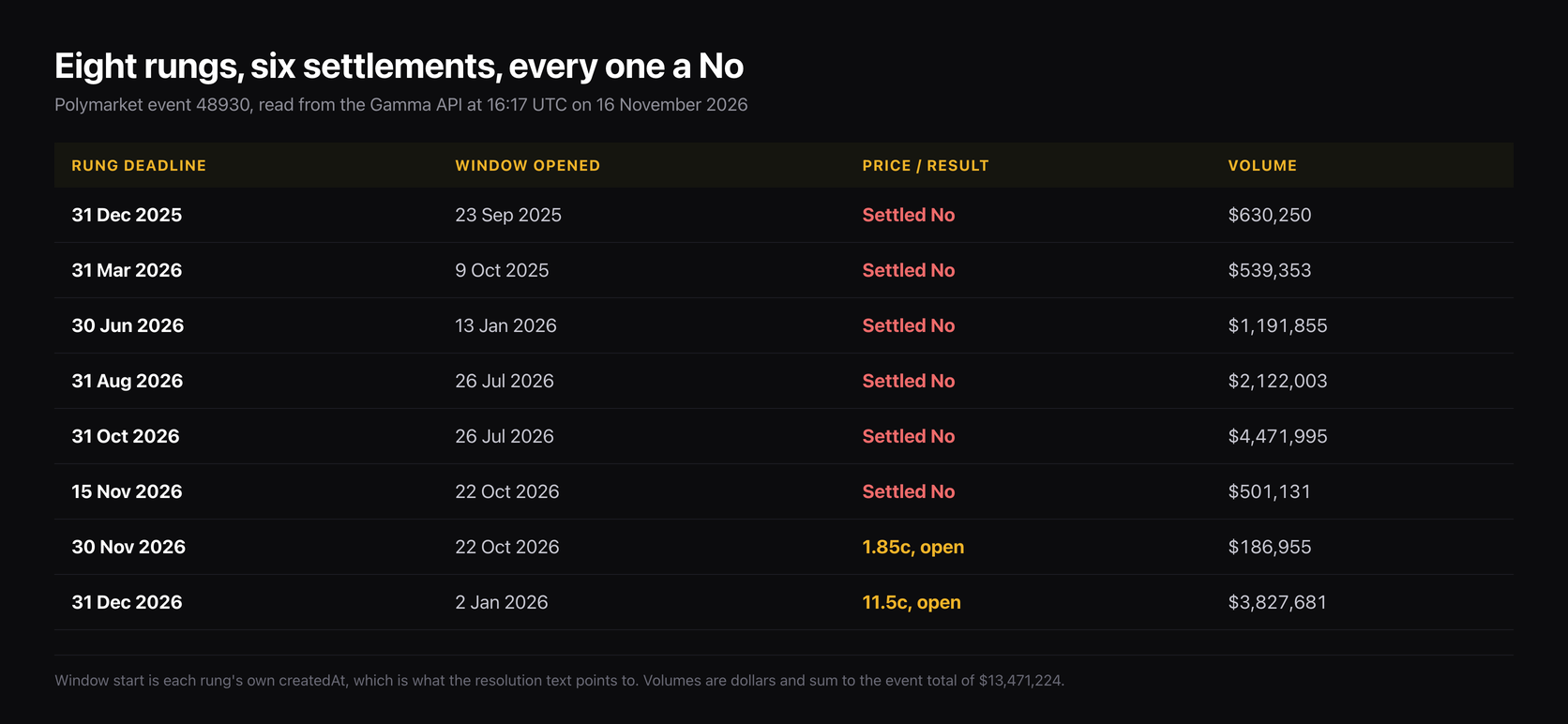
The board is a date ladder. Each rung asks the same question with a later deadline, and crucially each one’s qualifying window starts when that rung was created, not when the event was. Six have reached their deadline and all six paid No.
| Rung deadline | Window opened | Price / result | Volume |
|---|---|---|---|
| 31 Dec 2025 | 23 Sep 2025 | Settled No | $630,250 |
| 31 Mar 2026 | 9 Oct 2025 | Settled No | $539,353 |
| 30 Jun 2026 | 13 Jan 2026 | Settled No | $1,191,855 |
| 31 Aug 2026 | 26 Jul 2026 | Settled No | $2,122,003 |
| 31 Oct 2026 | 26 Jul 2026 | Settled No | $4,471,995 |
| 15 Nov 2026 | 22 Oct 2026 | Settled No | $501,131 |
| 30 Nov 2026 | 22 Oct 2026 | 1.85¢ — open | $186,955 |
| 31 Dec 2026 | 2 Jan 2026 | 11.5¢ — open | $3,827,681 |
Look at the bottom two lines together, because they are the whole market. The 31 December rung has been open since 2 January — 318 days — and it has not resolved. That is not a forecast; it is a fact about the past. Had anything in those 318 days met the definition, the rung would have paid out the day it happened.
The two live rungs also price each other. At 1.85¢ for 30 November and 11.5¢ for 31 December, the implied probability for December alone is 9.83% — which works out at 0.333% a day against 0.133% a day for the fortnight that remains of November. The market is pricing December as two and a half times more dangerous per day than the rest of this month.
What counts as a clash — and what the rules throw out
The operative sentence is short: the market resolves Yes on “a military encounter between the military forces of a NATO country and Russia,” defined as any incident involving the use of force, such as missile strikes, artillery fire or an exchange of gunfire. Then come four paragraphs of exclusions, and they do the real work.
| Rulebook clause | Effect | Bears on |
|---|---|---|
| Use of force between NATO and Russian forces | QUALIFIES | The core test |
| Shooting down a UAV that is not a munition | QUALIFIES | Named: MQ-9, Orlan-10, Orion, TB2 |
| Airspace violations | Excluded | Baltic and Romanian incursions |
| Warning shots | Excluded | Black Sea encounters |
| Cyberattacks | Excluded | Sabotage campaign |
| Intercepting one-way attack munitions aimed at a 3rd party | Excluded | Geran-2 / Geran-4 shoot-downs |
| Intentional collisions, incl. naval ramming | Excluded | Aerial interceptions |
| Contractors not under direct state command | Excluded | Deniable operations |
Read the two drone clauses next to each other and the design becomes obvious. Destroy a Russian reconnaissance aircraft — an Orlan-10, an Orion — and the market pays. Destroy a Russian attack munition that was flying at Ukraine when it strayed, and it does not, however many of them you shoot down and whoever’s airspace they were in.
That single distinction is why a year of air-defence engagements has produced six No settlements. It also leaves a genuine ambiguity the market has had to rule on: a munition heading into NATO airspace is arguably no longer aimed at a third party. The resolver has taken the narrow reading every time it has been asked.
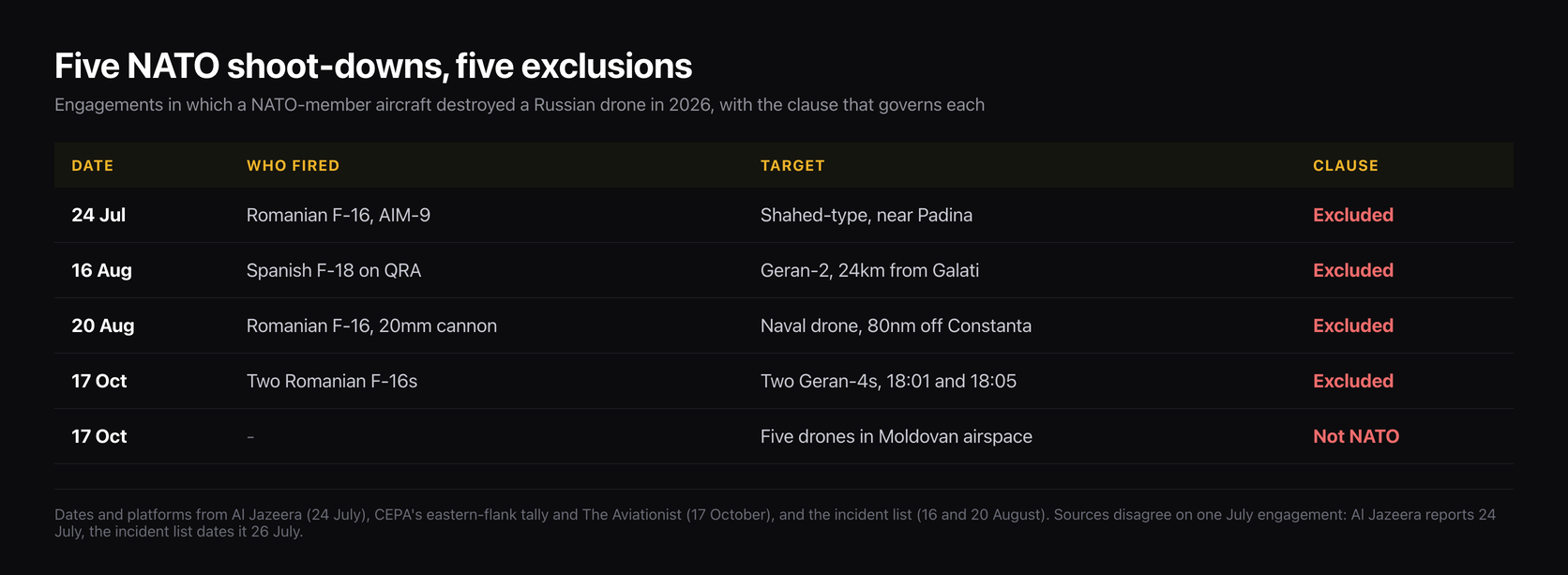
NATO jets have destroyed Russian drones five times
This is the part the price mirrors never put next to the price. Across 2026, fighters belonging to three NATO members have destroyed Russian drones over or beside Romanian territory on at least four separately sourced dates — with a missile, with a cannon, and over water.
| Date | Who fired | Target | Clause |
|---|---|---|---|
| 24 Jul | Romanian F-16, AIM-9 | Shahed-type, near Padina | Excluded |
| 16 Aug | Spanish F-18 on QRA | Geran-2, 24km from Galați | Excluded |
| 20 Aug | Romanian F-16, 20mm cannon | Naval drone, 80nm off Constanța | Excluded |
| 17 Oct | Two Romanian F-16s | Two Geran-4s, 18:01 and 18:05 | Excluded |
| 17 Oct | — | Five drones in Moldovan airspace | Not NATO |
The 20 August case is the most interesting of the four, and the closest the year has come. An F-16 made three strafing runs on a Russian naval drone 80 nautical miles off Constanța; Romania’s defence minister said explicitly that it was not Ukrainian, and the president attributed it to Russia. A one-way attack vessel is still a munition, so the clause holds — but it was in Romania’s own economic zone, aimed at nothing else in particular.
Context, because it matters for how this reads: on 29 May a Geran-2 hit a ten-storey apartment block in Galați and injured a woman and her 14-year-old son, the first strike on a populated area in a NATO country. Romania closed Russia’s consulate-general in Constanța and later recalled its ambassador from Moscow. None of that is a military encounter between armed forces, so none of it is in this contract.
The 23 October sinking: 25¢ to 10.5¢ in a day
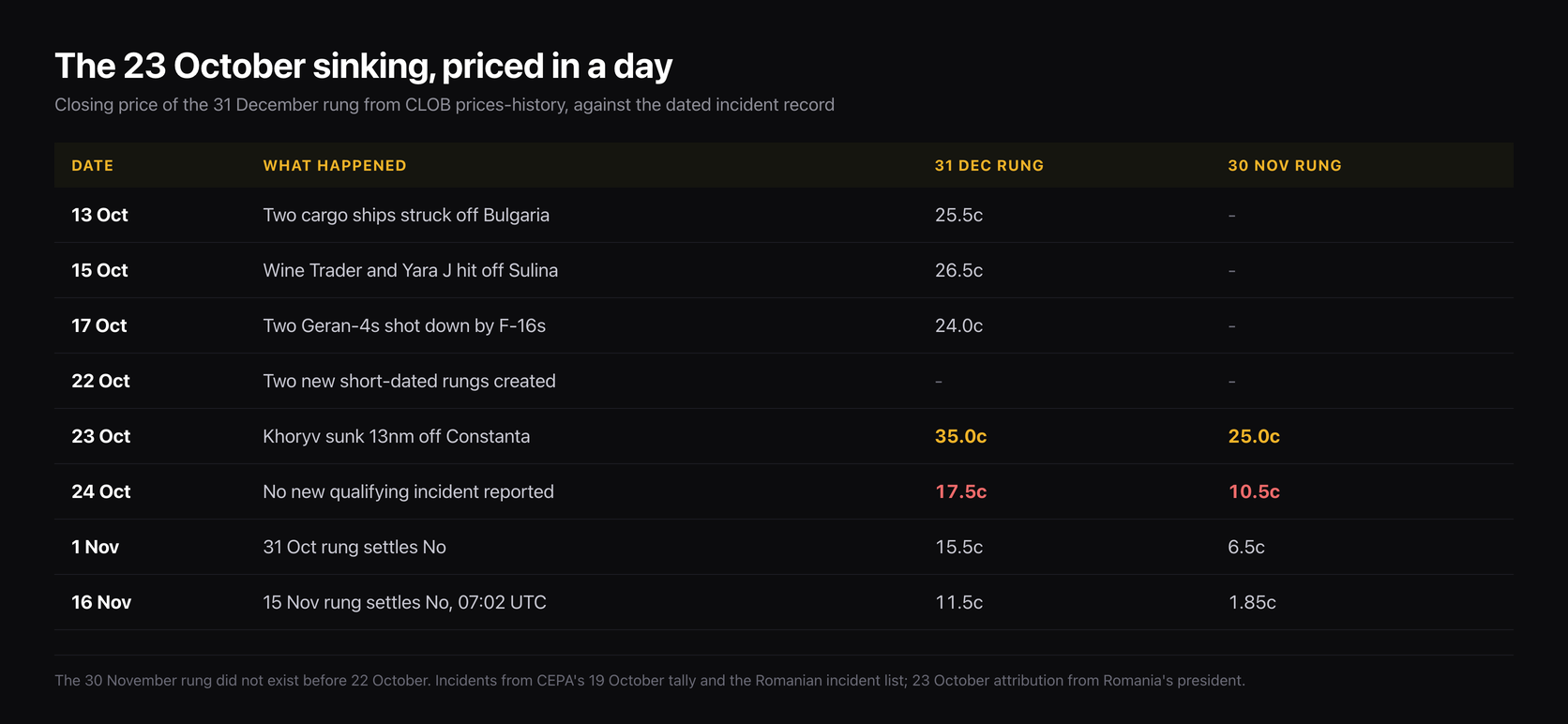
October was the worst month of the year on NATO’s eastern flank and the worst month of the year for this contract’s price. Both statements are true, and watching them happen together is the clearest demonstration of what the rulebook does.
| Date | What happened | 31 Dec rung | 30 Nov rung |
|---|---|---|---|
| 13 Oct | Two cargo ships struck off Bulgaria | 25.5¢ | — |
| 15 Oct | Wine Trader and Yara J hit off Sulina | 26.5¢ | — |
| 17 Oct | Two Geran-4s shot down by F-16s | 24.0¢ | — |
| 22 Oct | Two new short-dated rungs created | — | — |
| 23 Oct | Khoryv sunk 13nm off Constanța | 35.0¢ | 25.0¢ |
| 24 Oct | No new qualifying incident reported | 17.5¢ | 10.5¢ |
| 1 Nov | 31 Oct rung settles No | 15.5¢ | 6.5¢ |
| 16 Nov | 15 Nov rung settles No, 07:02 UTC | 11.5¢ | 1.85¢ |
The 23 October line is the one to sit with. The Khoryv was hit by a drone and sank 13 nautical miles off Constanța, just outside Romania’s territorial waters; one crew member died, three were missing, nine were rescued; and Romania’s president said that day it was a Russian drone, a week after saying there was no technical proof. The 31 December rung printed 35¢, its highest since January, and the newborn 30 November rung opened at 25¢.
One day later they were 17.5¢ and 10.5¢. Nothing on the ground had reversed, and no new incident was reported in between. What the contract requires is a use of force between armed forces, and a Comoros-flagged freighter with a civilian crew is not one — a reading both rungs whose windows covered that night have now confirmed by settling No, the second of them this morning.
Six rungs, six settlements, every one a No
The settlement record is the cheapest due diligence available on this board and almost nobody quotes it. Of the event’s $13.47 million lifetime volume, $9.46 million sits in rungs that have already paid nothing at all, against $4.01 million in the two still open.
The 31 October rung is the instructive one. It was created on 26 July and ran to the end of October, so its window contained the 16 and 20 August engagements, the 17 October double shoot-down and the Khoryv. It was also the single most-traded rung on the board at $4.47 million. It paid zero.
A clash prices at 6.8× an invasion
Polymarket runs four separate NATO-facing contracts for the end of 2026, and lined up they give a cleaner read than any single one of them. The order is sensible, which is itself worth knowing — it is not always, as our Greenland piece found on three contracts that priced out of sequence.
| Contract | Price | Multiple of clash | Rung volume |
|---|---|---|---|
| NATO × Russia military clash | 11.50¢ | 1.0× | $3,827,681 |
| Russia × Ukraine ceasefire agreement | 11.50¢ | 1.0× | $3,497,126 |
| Russia invades a NATO country | 1.70¢ | 0.15× | $527,169 |
| US withdraws from NATO | 0.75¢ | 0.07× | $1,371,239 |
A clash at 11.5¢ against an invasion at 1.70¢ means the market prices some exchange of fire at 6.8 times an actual attack on alliance territory, and a US exit from NATO at a fifteenth of the clash. Nothing there is surprising. It is the first line and the second that are the coincidence worth noting: the market gives the same 11.5¢ to a NATO–Russia clash and to a Russia–Ukraine ceasefire inside the same 45 days, with the ceasefire ladder then climbing to 53.5¢ by mid-2027.
If you only track one of these, track the ceasefire ladder instead of this one. It has ten times the open rungs, it prices a continuum rather than a definitional edge case, and we broke down the clause it turns on in Ukraine ceasefire odds 2026.
Kalshi has no NATO–Russia market at all
Our usual move on a board this size is to check the other exchange. On this one there is nothing to check. We walked Kalshi’s public events feed to exhaustion — 97 cursor pages, 19,290 open events and 168,846 open markets — and there is no NATO–Russia conflict contract anywhere in it.
| Kalshi series | What it prices | Class |
|---|---|---|
| KXGDPNOM-RUS26 | Russia nominal GDP in 2026 | Economics |
| KXCBDECISIONRUSSIA-26DEC18 | Bank of Russia December rate decision | Economics |
| KXUE-RUS26NOV | Russia unemployment rate | Economics |
| KXRUSDIESELIMPORT-27 | When Russian diesel reaches the US | Politics |
| KXFLIGHTSRUSSIA-25 | US direct flights to Russia resuming | Politics |
| KXELECTUKRAINE-30JAN01 | When Ukraine holds a presidential election | Elections |
| KXUKRAINEEU-27JAN01 | Ukraine as an EU associate member | Politics |
| KXNEXTNATOSECGEN-99 | Next NATO Secretary General | Elections |
| — none — | Any NATO–Russia military clash | Absent |
The shape of that list is the finding. Kalshi will happily sell you Russia’s GDP, its policy rate, its unemployment print and the date its diesel reaches American refineries. It will not sell you war risk. Polymarket has $13.47 million of it on one board.
For a reader that has a practical consequence: there is no second price to sanity-check 11.5¢ against, and the venue comparisons we run elsewhere — such as the nine-point gap between two Hegseth boards in Hegseth out odds 2026 — simply cannot be run here. One book, one rulebook, one number.
Every NATO Russia clash odds figure on page one is a mirror
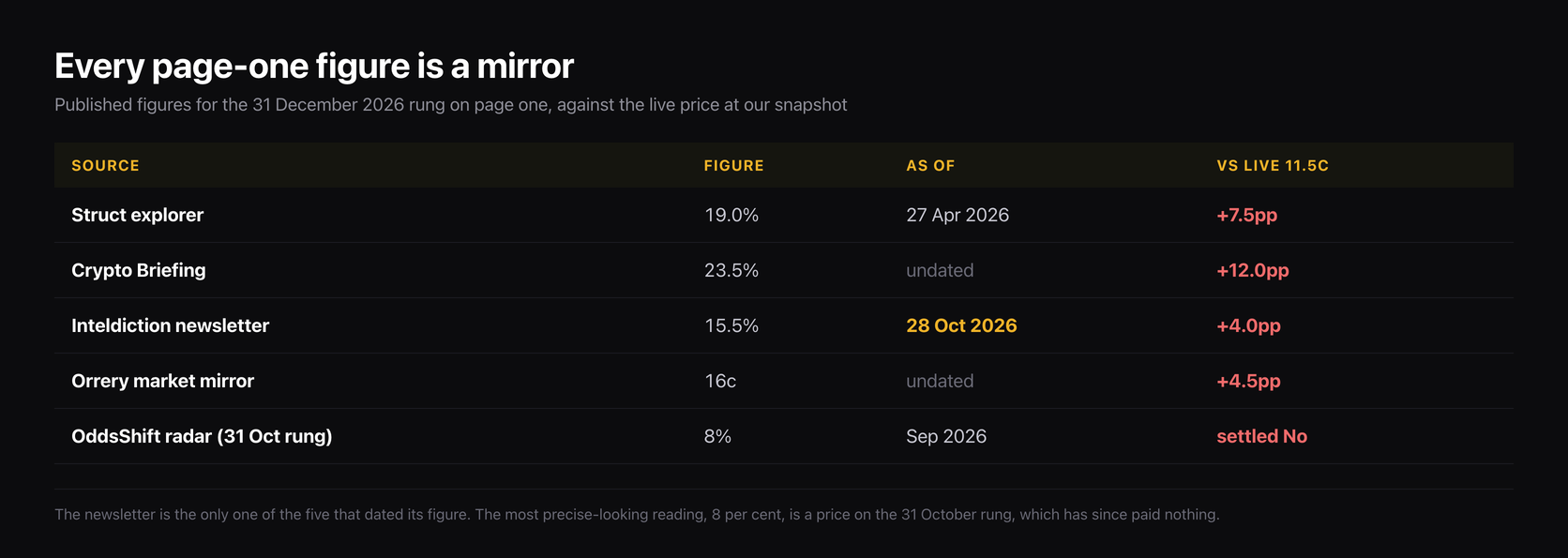
The first page of results for this market is made of price mirrors: pages that re-publish a Polymarket number, sometimes with a chart, occasionally with a hex transaction ID for a URL. None of them reads the resolution text, and all of them are above the live price.
| Source | Figure | As of | vs live 11.5¢ |
|---|---|---|---|
| Struct explorer | 19.0% | 27 Apr 2026 | +7.5pp |
| Crypto Briefing | 23.5% | undated | +12.0pp |
| Inteldiction newsletter | 15.5% | 28 Oct 2026 | +4.0pp |
| Orrery market mirror | 16¢ | undated | +4.5pp |
| OddsShift radar (31 Oct rung) | 8% | Sep 2026 | settled No |
The newsletter is the honest one of the five — it reported the drop and dated it. The rest are snapshots presented as current, and the most precise-looking of them, an 8% reading, is a price on the 31 October rung, which has since paid nothing.
What would actually have to happen in 45 days
Forty-five days remain on the 31 December rung. Here is what the 11.5¢ is buying, stated in the contract’s own terms rather than in the language of the news.
A reconnaissance drone, not an attack drone. The rulebook names the Orlan-10, the Orion and the Bayraktar TB2 as airframes whose destruction qualifies. A NATO member downing a Russian ISR platform rather than another Geran is the likeliest qualifying path, and it is a near-identical engagement to four that have already happened and not counted.
Fire between armed forces, in either direction. An exchange of gunfire on the Belarusian border, artillery across a frontier, a missile that hits a NATO military installation. Note that the clause is symmetrical: a NATO strike on Russian forces qualifies exactly as a Russian strike on NATO forces does.
Not a ship, not a cable, not a Starlink mast.Freighters have been sunk in NATO economic zones with crew killed, Starlink installations have been burned in Poland, Bulgaria and Lithuania, and CEPA counted seventeen attacks on the frontline states and Moldova in a month. None of that is a military encounter between armed forces, so none of it moves this contract on settlement — only on sentiment, which is what 23 October was.
Or nothing, which is what six rungs have paid. If you track one thing here, track the definition rather than the headline count. Our biggest daily movers page shows where the money is actually going, the Russia–Ukraine hub collects every related board, and the live clash board refreshes every ten minutes.
Related articles
- Ukraine ceasefire odds 2026: the 10-day clause
- Will China invade Taiwan? The odds, and what they cover
- Russia election odds 2026: one word splits the market
- Bab el-Mandeb odds 2026: right number, wrong strait
- World leader out odds 2026: the caretaker clause
- How GeoOdds reads prices, volume and resolution rules
New to prediction markets?
New traders get a $20 bonus
Deposit $10 on Polymarket and get a $20 trading bonus to put behind your first call.
See the live NATO × Russia board on Polymarket →New Polymarket users only. Bonus is trading credit, expires 30 days after it lands, and terms are set by Polymarket — check the current offer at signup. 18+. Fee-free markets. GeoOdds earns a commission on signups through this link.
Frequently asked questions
What are the NATO Russia clash odds for 2026?
At 16:17 UTC on 16 November 2026, Polymarket pays 11.5¢ that there is a NATO–Russia military clash by 31 December 2026 and 1.85¢ by 30 November. Six earlier rungs on the same board, running from December 2025 to 15 November 2026, have all settled No. The event has traded $13.47 million since September 2025.
What does Polymarket count as a NATO–Russia military clash?
The contract needs “a military encounter between the military forces of a NATO country and Russia” — missile strikes, artillery fire, an exchange of gunfire or other direct engagement. It then excludes four things by name: airspace violations, warning shots, cyberattacks, and intentional collisions such as an aerial interception or a naval ramming without weapons. It also excludes intercepting one-way attack or loitering munitions, Shahed-type drones among them, when those munitions are aimed at a third party rather than at NATO.
Why did Romania shooting down Russian drones not resolve this market Yes?
Because the rulebook splits drones in two. Shooting down a reconnaissance UAV that is not a munition — it names the MQ-9, Orlan-10, Orion and Bayraktar TB2 — qualifies. Intercepting a one-way attack munition aimed at a third party does not, and the Geran-2 and Geran-4 airframes Romanian and Spanish fighters have engaged in 2026 are Shahed-type attack munitions flying towards Ukraine. The rungs whose windows covered those engagements settled No.
Has any rung of this market ever settled Yes?
No. All six resolved rungs paid No: the 2025 rung, then 31 March, 30 June, 31 August, 31 October and 15 November 2026. The 15 November rung resolved at 07:02 UTC on 16 November, hours before this page was written. $9.46 million of the event's $13.47 million lifetime volume sits in rungs that have already paid nothing.
Does Kalshi have a NATO–Russia clash market?
No. We swept Kalshi's public events feed to exhaustion — 97 pages, 19,290 open events and 168,846 open markets — and found no NATO–Russia conflict contract of any kind. Its Russia exposure is entirely economic or electoral: nominal GDP, the Bank of Russia rate decision, the unemployment rate, when Russian diesel will be imported into the US, and when Ukraine will hold a presidential election. So there is no second price to check this one against.
What are the odds Russia invades a NATO country in 2026?
Polymarket pays 1.70¢ on that contract for 31 December 2026, against 11.5¢ for a military clash — so the market prices a clash at 6.8 times an invasion. A separate contract on the US withdrawing from NATO before 2027 pays 0.75¢. All three sit on the same board family and have never resolved Yes.
Is 11.5¢ too low given the attacks on NATO's eastern flank?
We will not call it mispriced, and nobody should from a single number. What the price buys is narrow: not escalation, not a sunk freighter, not another drone shot out of the sky, but a use of force between NATO and Russian armed forces that survives four written exclusions, inside 45 days. Read against the rulebook rather than the headlines, 11.5¢ and a month of attacks on NATO's frontline states are not in contradiction.
Sources: prices, rung creation dates, settlement status and the full resolution text from the Polymarket Gamma and CLOB public APIs (event 48930, all eight rungs plus daily closes for both open ones, and events 25413, 73196 and 478472 for the comparison table), read at 16 November 2026, 16:17 UTC; the clash board carries the operative text quoted above. Implied probabilities, per-day rates and the multiples are arithmetic on those prices and are not forecasts. Kalshi coverage is our own complete cursor sweep of its public events API. The eastern-flank tally of seventeen attacks in a month, the 17 October shoot-down of two Geran-4 drones and the Starlink arson in Poland, Bulgaria and Lithuania are as reported by CEPA on 19 October 2026; the 24 July Romanian F-16 engagement by Al Jazeera, which dates it a day or two earlier than Wikipedia’s Romanian incident list, the source for the 16 and 20 August engagements, the Galați apartment strike and the sinking of the Khoryv; and the 17 October intercept detail by The Aviationist. This page does not assert who carried out any individual attack; it reports the attributions those sources record and what the contract does with them. Polymarket volume and liquidity are dollars; Kalshi carries no comparable contract, and the two venues’ figures are never added here. Live numbers are on the market pages, which refresh every 10 minutes. Nothing here is financial or betting advice.