
Polymarket vs Kalshi: Venezuela Leader Odds 2026
Published 4 September 2026 · Prices frozen 4 September 2026, 21:12 UTC
Key takeaways
- The favourite is in a Brooklyn jail. Polymarket has Nicolás Maduro at 82.7¢ and Kalshi at 84¢ to be Venezuela’s head of state on 31 December 2026, eight months into US federal detention.
- The two exchanges agree, to 1.3 points. On the headline question the cross-exchange gap is smaller than the bid-ask spread on most of the field.
- Kalshi’s second market prices the opposite answer. Its “de facto” contract has Delcy Rodríguez at 95¢ and Maduro at 5¢ — a 79-point inversion driven entirely by two words of resolution wording.
- The board flipped in five days in April. Maduro went 19.2¢ → 57.7¢ between 15 and 20 April 2026 while Rodríguez fell 62¢ → 32¢, tracking a rules clarification rather than any event in Caracas.
- Nobody expects a vote. An election merely being scheduled by year-end prices at 16.5¢ on Polymarket; one actually being held prices at 8¢ on Kalshi.

If you look up Venezuela leader odds expecting the market to name whoever is running the country, you will misread every price on the board. The most-traded outcome on a $96m Polymarket event is a man who has been in a federal detention centre in Brooklyn since 3 January 2026, and the second-largest is the woman who has been signing Venezuela’s decrees ever since. Both are correctly priced, because the two exchanges are not asking what you think they are asking.
This piece puts every Polymarket and Kalshi Venezuela contract side-by-side at a single frozen timestamp, works out where the two venues genuinely disagree, and traces the five-day window in April when the whole board inverted. We pulled the numbers ourselves from the Polymarket Gamma and CLOB endpoints and Kalshi’s public trading API, and we read both sets of resolution criteria line by line — which is where the real story turned out to be.
Where the Venezuela leader odds stand today
Polymarket’s Venezuela leader end of 2026 market is one of the largest geopolitical events on the platform: $96.0m in lifetime volume against $1.59m of resting liquidity. Forty-odd names are listed. Five of them carry a price you would notice.
| Outcome | Price | Implied | Volume |
|---|---|---|---|
| Nicolás Maduro | 82.7¢ | 82.7% | $2.82m |
| Delcy Rodríguez | 11.0¢ | 11.0% | $1.78m |
| María Corina Machado | 1.8¢ | 1.8% | $1.46m |
| No Head of State | 0.9¢ | 0.9% | $1.52m |
| Edmundo González | 0.4¢ | 0.4% | $1.22m |
| Diosdado Cabello Rondón | 0.3¢ | 0.3% | $2.09m |
| Everyone else (34 names) | ≤0.2¢ | ≤0.2% | — |
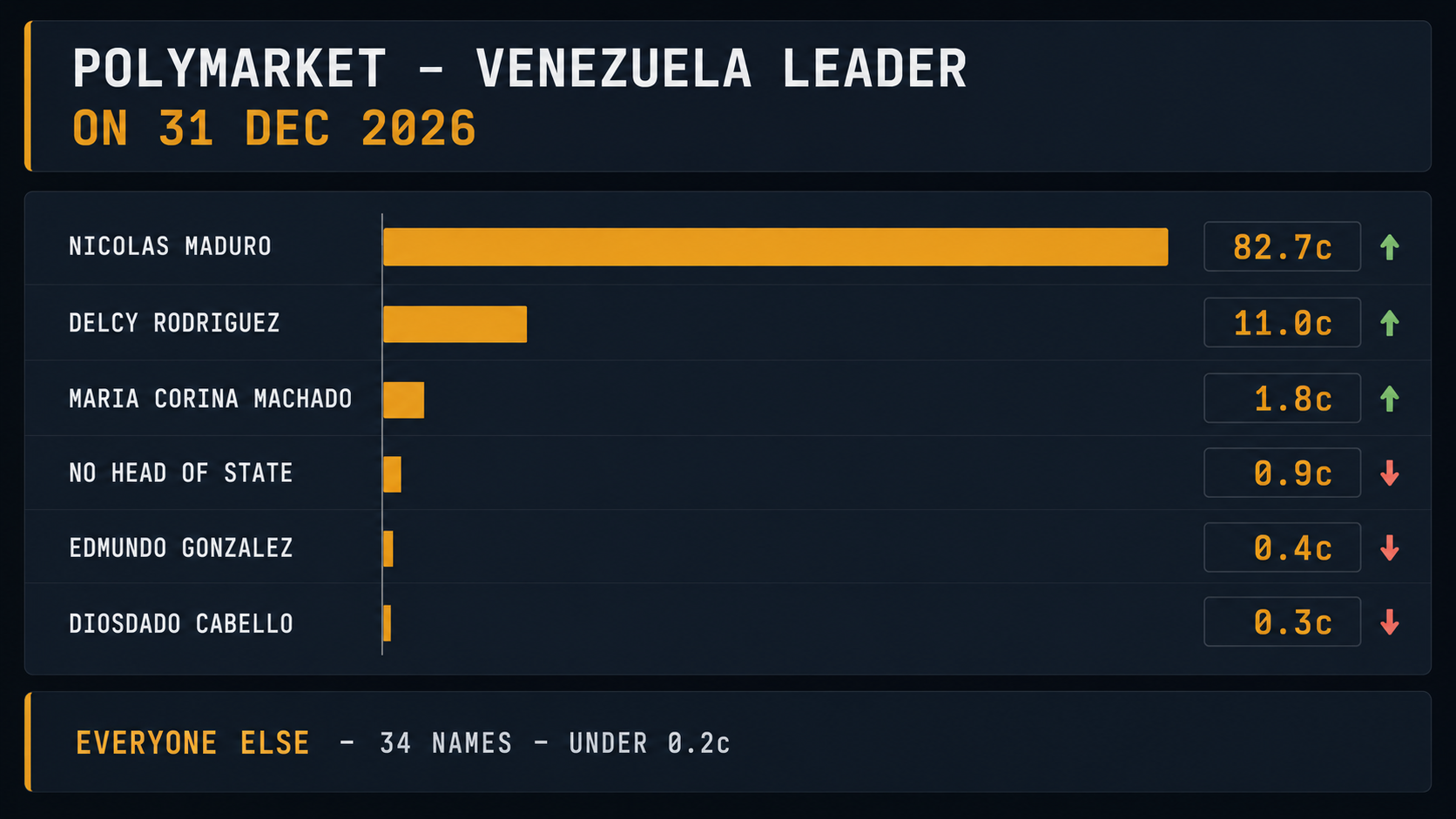
The shape is unusual. A market this size normally has a long tail of one-cent names and a favourite somewhere in the 40s or 50s. Here the favourite is at 83¢ and the runner-up at 11¢, and the two of them are the only outcomes above two cents. That is a market that has stopped arguing about the world and started agreeing about a definition.
Polymarket vs Kalshi: the same question, priced line by line
Kalshi lists the equivalent contract as KXVENEZUELALEADER-26DEC31, “Who will officially lead Venezuela at the end of 2026?”. It has turned over $5.25m with $1.18m of open interest — a fifth of Polymarket’s volume, but deep enough to take seriously. Here is every outcome the two venues share.
| Outcome | Polymarket | Kalshi last | Kalshi bid–ask | Gap |
|---|---|---|---|---|
| Nicolás Maduro | 82.7¢ | 84.0¢ | 84–86¢ | +1.3 |
| Delcy Rodríguez | 11.0¢ | 11.0¢ | 13–15¢ | 0.0 |
| Diosdado Cabello Rondón | 0.3¢ | 3.7¢ | 1–4¢ | +3.4 |
| María Corina Machado | 1.8¢ | 3.5¢ | 1–4¢ | +1.7 |
| Vladimir Padrino López | 0.2¢ | 2.9¢ | 2–3¢ | +2.7 |
| Donald Trump | 0.1¢ | 2.0¢ | 2–2¢ | +1.9 |
| No Head of State | 0.9¢ | not listed | — | n/a |
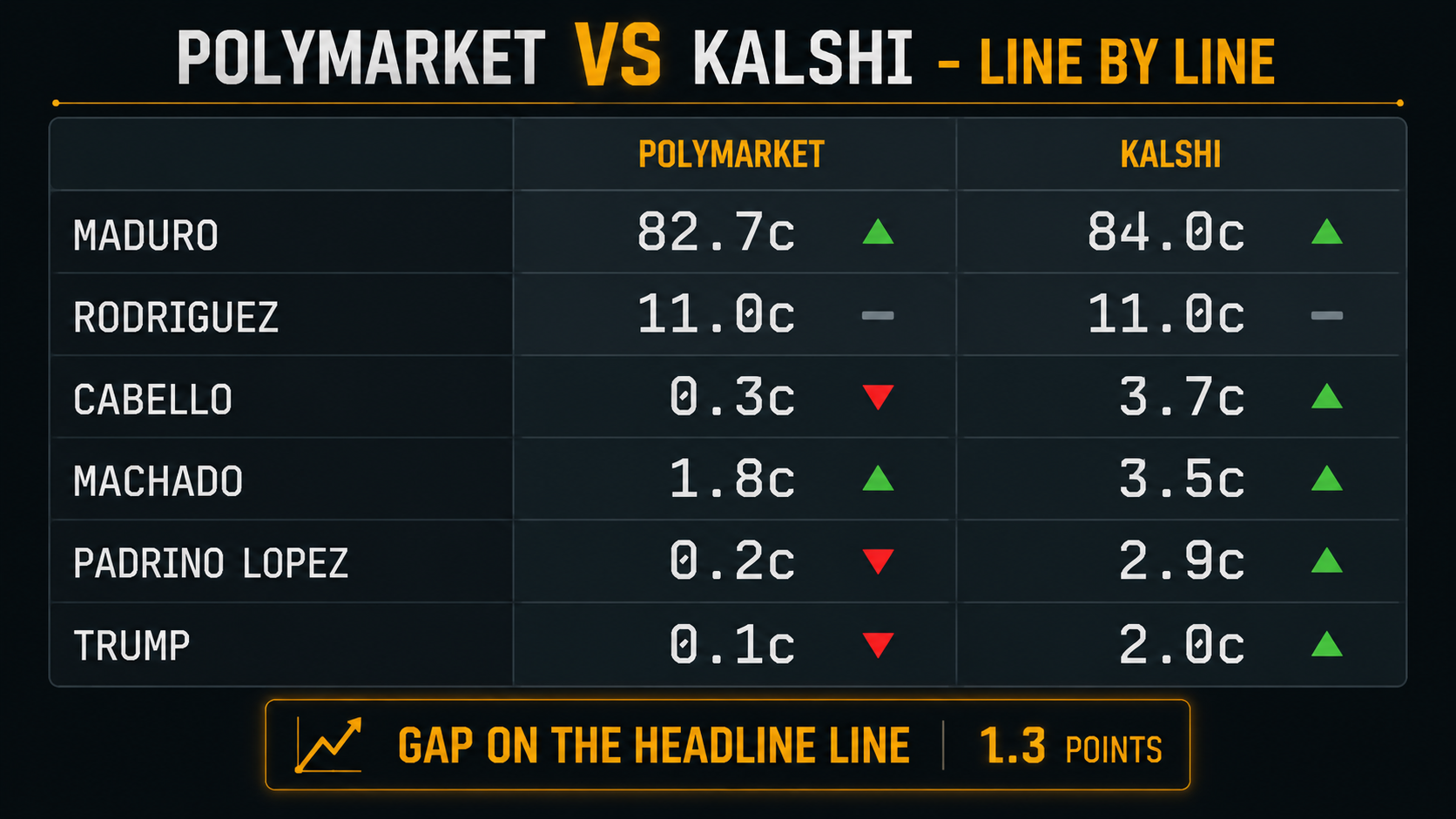
On the only outcome that carries real money, the two exchanges are 1.3 points apart. That is inside the noise: Kalshi’s own book on that line is quoted 84 bid, 86 offered, so Polymarket’s 82.7¢ sits barely outside a two-point spread. Cross-exchange arbitrage on the headline is not there.
The tail is a different story. Cabello prints 3.7¢ on Kalshi against 0.3¢ on Polymarket, and Padrino López 2.9¢ against 0.2¢. Those look like double-digit relative gaps, and they are — but the Kalshi quotes behind them are 1 bid, 4 offered. A last trade at 3.7¢ on a book that wide is a record of one trade, not a consensus. We treat anything below five cents on either venue as unpriced.
Kalshi’s second Venezuela market prices the opposite answer
Kalshi does something Polymarket does not: it runs a second leadership market on the same date with a deliberately different test. KXVENEZDEFACTO-27JAN01 asks who will de facto hold the office — who actually exercises the powers, “regardless of formal title, constitutional designation, formal appointment, domestic legal status, foreign recognition, or international recognition”.
Change that one clause and the board turns upside down.
| Person | Officially holds | De facto holds | Spread |
|---|---|---|---|
| Nicolás Maduro | 84.0¢ | 5.0¢ | −79.0 |
| Delcy Rodríguez | 11.0¢ | 95.0¢ | +84.0 |
| María Corina Machado | 3.5¢ | 3.0¢ | −0.5 |
| Diosdado Cabello | 3.7¢ | 2.0¢ | −1.7 |
| Vladimir Padrino López | 2.9¢ | 2.0¢ | −0.9 |
| Total volume | $5.25m | $36.9k | — |
| Open interest | $1.18m | $24.1k | — |
| Volume, last 24h | $1,563 | $0 | — |
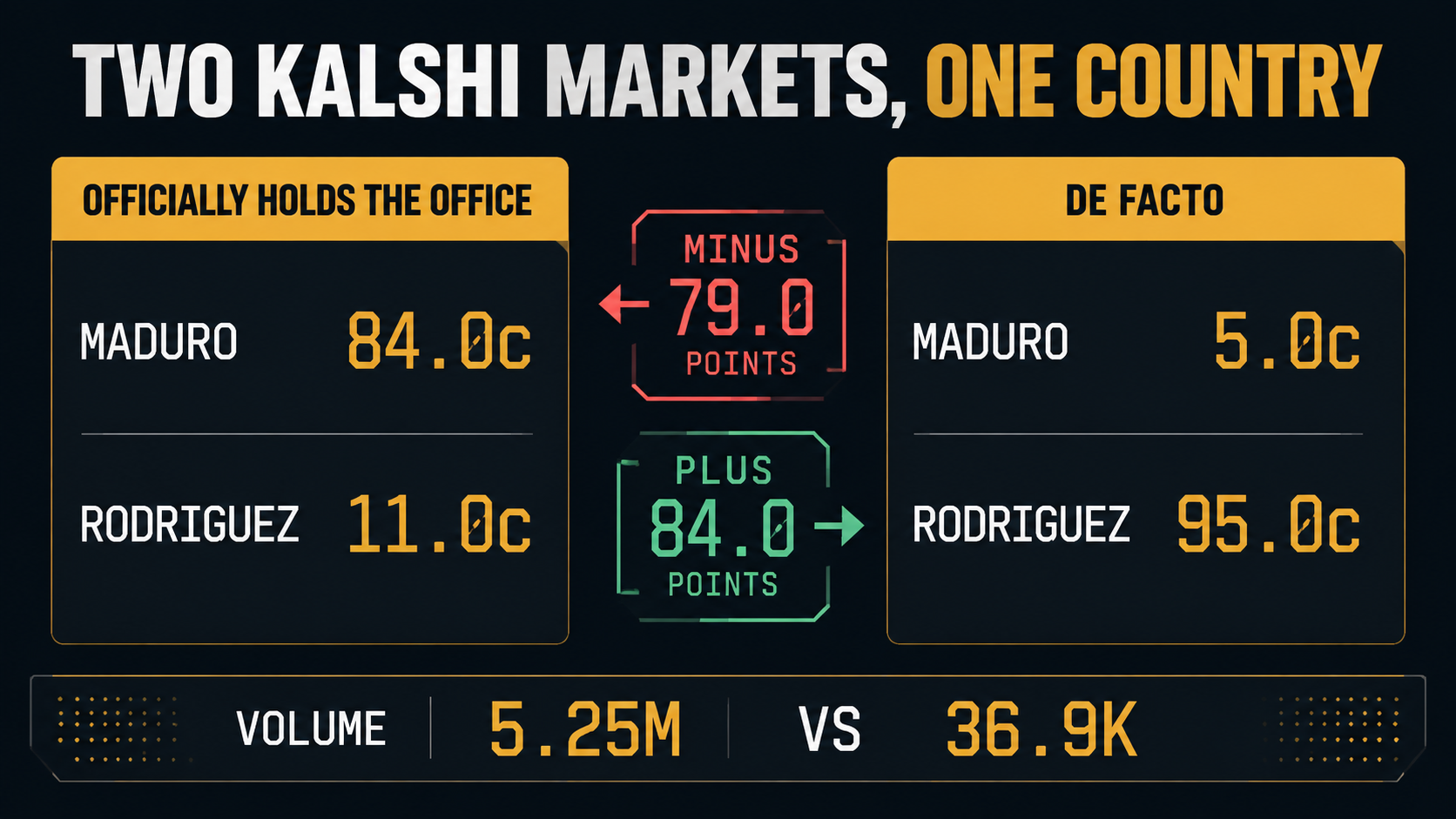
Two words of resolution language are worth 79 percentage points on Maduro and 84 on Rodríguez. Nothing about Venezuela changes between the two contracts. Only the question does.
The honest caveat is size. The de facto market has traded $36,900 in its life and nothing at all in the last 24 hours, against $5.25m on the official market. Rodríguez’s 89-bid, 94-offered book there is genuinely two-sided, so it is not a dead quote — but a five-point spread on a market that thin is a wide band, and we would not build a position on the last trade alone.
Why “officially holds” keeps Maduro on top
The facts on the ground are not in dispute. US forces captured Maduro and his wife Cilia Flores on 3 January 2026 and flew them out of the country; he was arraigned in New York on 5 January on narco-terrorism and cocaine-trafficking conspiracy charges, pleaded not guilty, and is held at the Metropolitan Detention Center in Brooklyn. The State Department’s own wanted listing now reads “Captured”. His trial is not scheduled until 1 June 2027 — five months after these markets resolve.
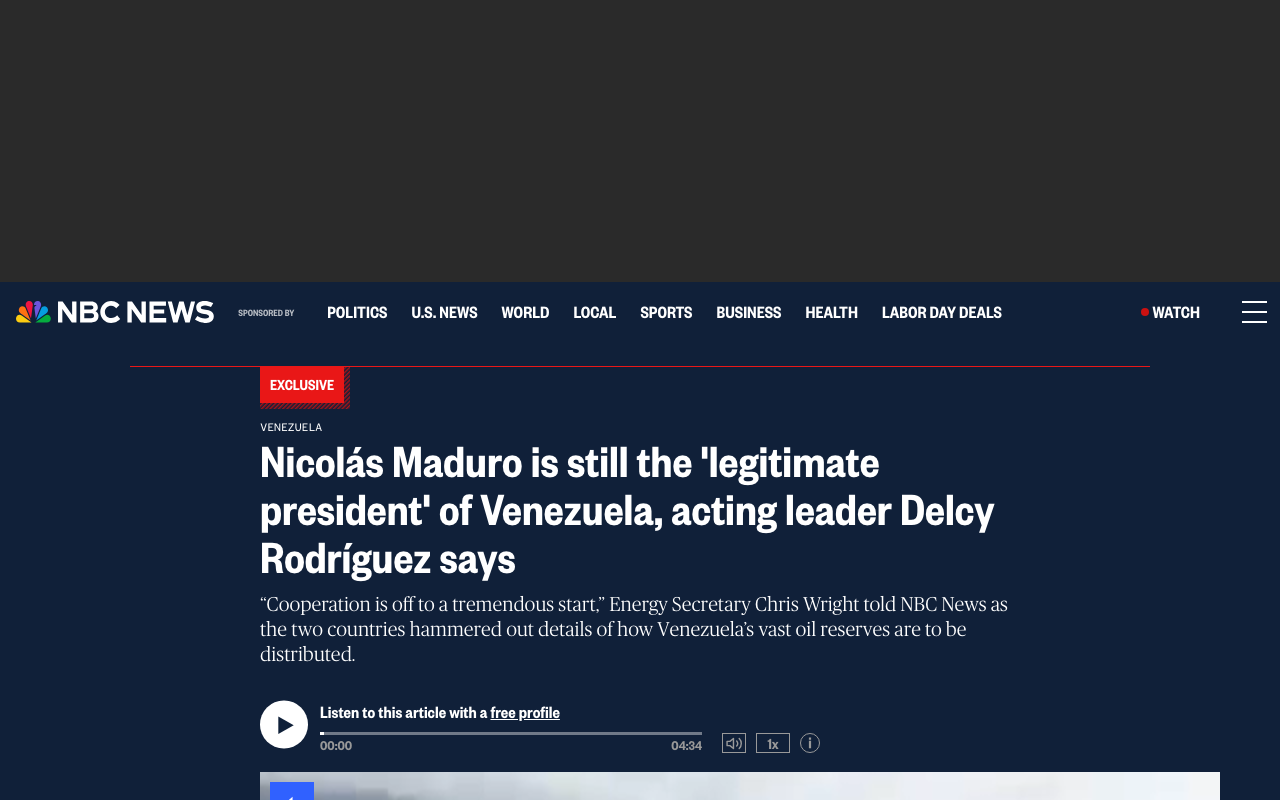
On 3 January Venezuela’s Supreme Tribunal of Justice ordered Vice-President Delcy Rodríguez to assume and exercise the office, reading the capture as a temporary inability rather than an absolute absence. She was sworn in as acting president on 5 January. That reading is the entire ballgame: a temporary inability leaves the officeholder in place. Rodríguez has said so herself, telling NBC News in February 2026, “President Nicolás Maduro is the legitimate president”, while adding that she is “in charge of the presidency of Venezuela, as it’s stated clearly in the constitution”.
Now read what the contracts actually require. Both venues define “officially holds” the same three ways: formally appointed and sworn in; listed as head of state in official government directories; or actively serving with full authority. Polymarket adds a tiebreaker — if the Venezuelan government does not clearly state who the head of state is, it defers to the UN protocol list of heads of state. Both exclude anyone “serving in an acting, interim, caretaker, provisional or temporary capacity”.
So an 83¢ Maduro price is not a bet that he walks out of Brooklyn. It is a bet that Caracas keeps calling him president for another sixteen weeks. The residual 17% is the chance that something forces the formalisation of a successor — a resignation, a constitutional ruling that converts the absence from temporary to absolute, or a negotiated transition.
The April repricing that flipped the whole board
For the first hundred days after the capture, Polymarket traded this market the way a newspaper would have written it: Rodríguez was running the country, so Rodríguez was the favourite, peaking around 64¢ in early spring. Maduro sat in the teens. Then, in five days in the middle of April, the two swapped places and never swapped back.
| Date | Maduro | Delcy Rodríguez | Machado |
|---|---|---|---|
| 6 Jan 2026 | 5.0¢ | 44.0¢ | 16.5¢ |
| 1 Feb 2026 | 10.6¢ | 61.0¢ | 15.5¢ |
| 1 Mar 2026 | 13.8¢ | 64.5¢ (28 Feb) | 13.5¢ (28 Feb) |
| 1 Apr 2026 | 16.8¢ (28 Mar) | 63.5¢ | 14.5¢ |
| 15 Apr 2026 | 19.2¢ (12 Apr) | 62.0¢ | 11.5¢ |
| 20 Apr 2026 | 57.7¢ (18 Apr) | 32.0¢ | 6.0¢ (18 Apr) |
| 1 May 2026 | 66.0¢ | 19.5¢ | 8.5¢ |
| 1 Jun 2026 | 67.5¢ | 20.5¢ | 5.2¢ |
| 1 Jul 2026 | 79.8¢ | 13.5¢ | 3.2¢ |
| 1 Aug 2026 | 81.7¢ | 9.5¢ | 3.1¢ |
| 1 Sep 2026 | 83.5¢ | 10.0¢ | 1.8¢ |
| 4 Sep 2026 | 82.7¢ | 11.0¢ | 1.8¢ |
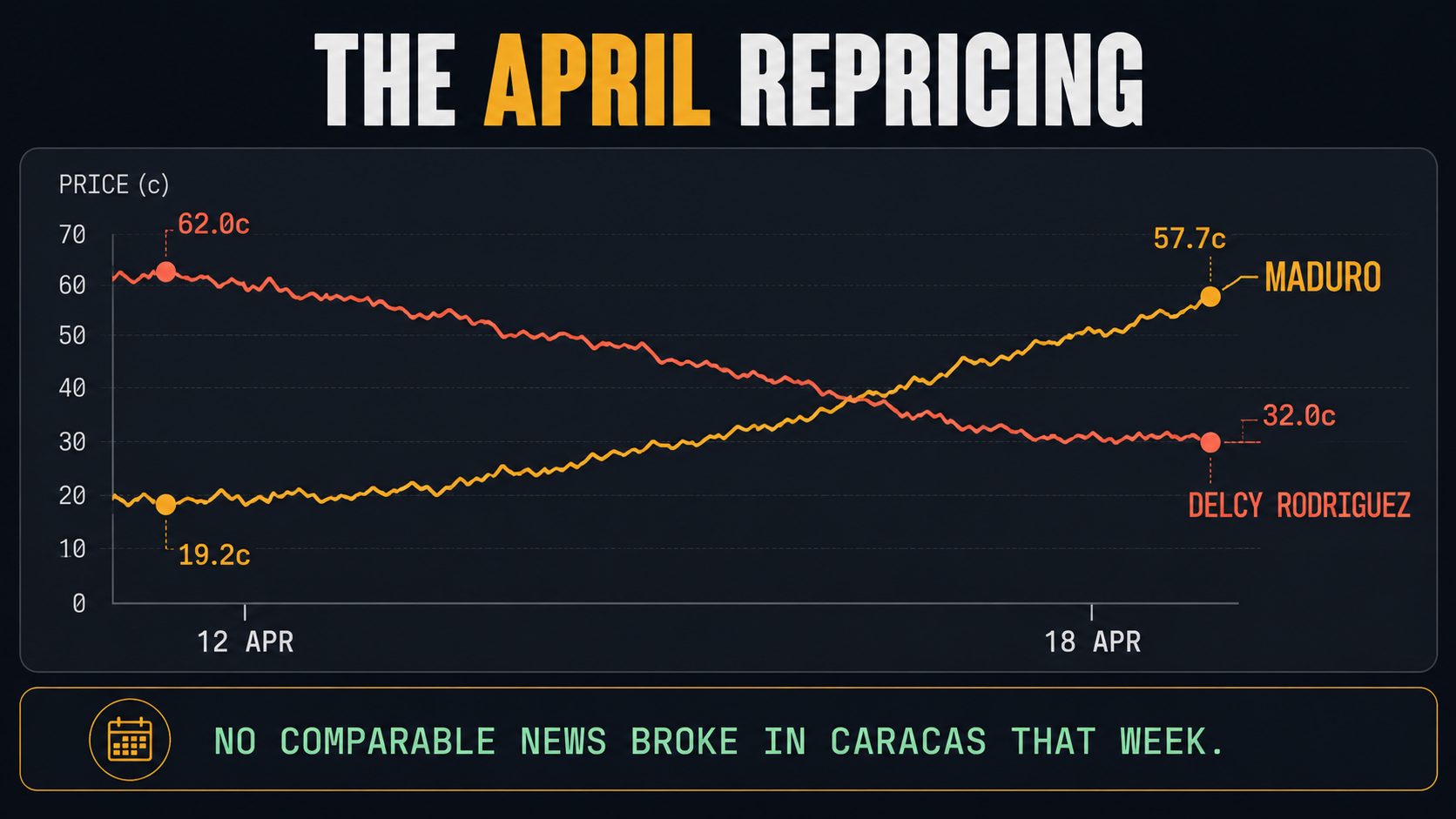
Between 15 and 20 April, Maduro gained 38.5 points and Rodríguez lost 30. The dates matter: Kalshi’s clarification on the equivalent market is stamped 15 April 2026, and Polymarket repriced over the following three sessions. We could not find a Venezuelan news event that week of anything like the magnitude the move implies — no ruling, no resignation, no announcement.
We cannot prove the clarification caused it, and we are not going to claim we can. But the sequence is the tell: a market that had spent a hundred days pricing who governs spent five days re-pricing what the contract says, and every move since has been a slow drift toward certainty rather than a reaction to Caracas. Compare the April jump with the whole of the summer: 38.5 points in five days, against 25 points over the next four months.
Rodríguez, meanwhile, has settled into the 9–13¢ band since July. Her contract is now the market’s price on formalisation — that the acting label gets dropped before the year ends. You can watch that line move on its own page, Delcy Rodríguez out as leader of Venezuela, or against everything else in the file on our Venezuela odds hub.
What the rest of the Venezuela board is pricing
The leadership contract is not the only Venezuela question with prices on both exchanges, and the rest of the board is where the wording differences get genuinely useful.
| Question | Polymarket | Kalshi | Note |
|---|---|---|---|
| Presidential election by year-end | 16.5¢ | 8.0¢ | scheduled vs held |
| Machado enters Venezuela by 30 Sep | 8.5¢ | 11.0¢ | same test |
| Machado enters Venezuela by 31 Dec | 30.0¢ | 20.0¢ | same test |
| Delcy Rodríguez out as leader by 31 Dec | 11.0¢ | not listed | — |
| Venezuela becomes 51st US state | 2.4¢ | not listed | — |
The election line is the one to sit with. Polymarket’s election-scheduled market pays out if a date is merely announced; Kalshi’s pays out only if Venezuelans actually vote. Scheduling is strictly easier than holding, so 16.5¢ against 8¢ is not a disagreement — it is two exchanges pricing two rungs of the same ladder, and the eight-point step between them is the market’s estimate of the gap between an announcement and a ballot box. On 2 September 2026 Rodríguez said an electoral process would happen “when Venezuela is ready” and declined to name a date, which is roughly what 8¢ looks like in prose.
The two Machado lines are closer to a genuine gap: Polymarket pays 30¢ for her entering the country by year-end where Kalshi’s last trade is 20¢, though Kalshi’s book there is quoted 24–27¢, which closes most of it. Her return-to-Venezuela market is the most liquid single-name contract on the file after the leadership event.
How to read a cross-exchange gap without getting burned
Venezuela is a good teacher here because it contains all three of the traps at once. A gap between two venues is only interesting after you have ruled out the boring explanations, and in this file the boring explanations account for nearly all of it.
- Different question. The 79-point Maduro inversion between Kalshi’s two markets is the extreme case, and the scheduled-versus-held election pair is the everyday one. Always read both resolution texts before calling anything mispriced.
- Different price type. A last trade is not a mid. Cabello’s 3.4-point “gap” collapses the moment you notice the Kalshi book behind it is 1 bid, 4 offered.
- Different depth. $96m of Polymarket volume and $36.9k of Kalshi de facto volume do not carry the same information. Weight by open interest, not by headline numbers.
- Different missing outcomes. Polymarket lists “No Head of State” at 0.9¢; Kalshi has no such line. A mutually-exclusive field that is missing an outcome does not sum to the same 100%, so the remaining names are all very slightly richer.
This is why our Kalshi comparison module only renders when a pair clears an 85% confidence threshold on titles, dates and resolution criteria, or when a human has pinned it. Two markets with the same headline and different rules are not a comparison. They are two different bets.
What could move these odds before 31 December
Sixteen weeks is not long, and the resolution date sits five months before Maduro’s trial. Four things would actually reprice this board, and none of them is a courtroom.
- A formalisation of the succession. A constitutional ruling converting Maduro’s absence from temporary to absolute, or a resignation, would move the official market at once. This is what the 11¢ on Rodríguez is buying.
- An election date. A named date resolves the scheduling contract and drags the leadership market with it, because a credible vote implies a formal handover.
- A negotiated US deal. Sanctions relief on the energy sector and a prisoner release in mid-August 2026 both point at an ongoing negotiation; a deal that touches Maduro’s status touches every line on this page.
- A further rules clarification. April demonstrated that on this file a clarification moves prices harder than the news does. Watch the market pages, not just the headlines.
The prices in this article are frozen at 4 September 2026, 21:12 UTC so the tables and the prose can never disagree with each other. For the live numbers, every market above has its own page that refetches Polymarket every ten minutes, and the day’s biggest swings across the whole site land on our movers page.
Related on GeoOdds
- Venezuela odds hub — every active market in one place
- Venezuela leader end of 2026 — live probability and chart
- Delcy Rodríguez out as leader of Venezuela — live odds
- Venezuela presidential election scheduled — live odds
- María Corina Machado enters Venezuela — live odds
- Methodology — how we match Polymarket and Kalshi markets
New to prediction markets?
New traders get a $20 bonus
Deposit $10 on Polymarket and get a $20 trading bonus to put behind your first call.
See this market on Polymarket →New Polymarket users only. Bonus is trading credit, expires 30 days after it lands, and terms are set by Polymarket — check the current offer at signup. 18+. Fee-free markets. GeoOdds earns a commission on signups through this link.
Frequently asked questions
Who is favoured to be Venezuela's leader at the end of 2026?
Nicolás Maduro. Polymarket priced him at 82.7¢ and Kalshi at 84¢ on 4 September 2026, even though he has been in US federal custody in Brooklyn since 3 January 2026. Both markets ask who officially holds the office, and Venezuela's Supreme Tribunal treated his capture as a temporary inability rather than a vacancy, so the state still names him president.
Why do Polymarket and Kalshi show different Venezuela odds?
On the headline question they barely differ — 82.7¢ against 84¢, about 1.3 points. The big gap is inside Kalshi, which runs two Venezuela leadership markets: one on who officially holds the office and one on who holds it de facto. Maduro is 84¢ on the first and 5¢ on the second.
What is the difference between the official and de facto Venezuela markets?
The official market resolves on formal title: appointment, swearing-in, and listing in government directories. The de facto market resolves on who actually exercises the powers of head of state, explicitly ignoring formal title and foreign recognition. Maduro holds the title; Delcy Rodríguez exercises the powers, so the two markets point at different people.
Is Delcy Rodríguez the president of Venezuela?
She is the acting president, sworn in on 5 January 2026 after the Supreme Tribunal's Constitutional Chamber ordered her to assume and exercise the office. She has publicly maintained that Maduro remains the legitimate president. That distinction is exactly what the two Kalshi markets price separately.
Why did the Maduro odds jump in April 2026?
Between 15 and 20 April 2026 Polymarket's Maduro contract went from 19.2¢ to 57.7¢ while Delcy Rodríguez fell from 62¢ to 32¢. Kalshi's official-leader market carries a clarification dated 15 April 2026 stating it would resolve Yes to Maduro if it expired that day. No comparable news broke in Caracas that week, so the repricing looks like traders re-reading the resolution criteria rather than reacting to events.
Will Venezuela hold a presidential election in 2026?
Markets doubt it. Polymarket gave 16.5¢ to an election merely being scheduled by 31 December 2026, and Kalshi gave 8¢ to one actually being held before 1 January 2027. Acting president Delcy Rodríguez said on 2 September 2026 that a vote would happen when the country is ready, without giving a date.
How reliable is the Kalshi de facto Venezuela market?
Treat it as directional, not precise. It had turned over about $37,000 in total with no volume in the previous 24 hours, against $5.25m on the official market and $96m on the Polymarket event. Delcy Rodríguez quoted 89–94¢ there is a real two-sided book, but a five-point spread on a thin market is a wide band.
Sources: Polymarket Gamma and CLOB public APIs (event 143443); Kalshi public trading API (KXVENEZUELALEADER-26DEC31, KXVENEZDEFACTO-27JAN01, KXELECTVENEZUELA, KXMACHADOVENEZUELA-26JUN29); US Department of State; NBC News. Prices captured 4 September 2026, 21:12 UTC and not updated since. Nothing here is investment advice — see our disclaimer.