
Taipei Mayor Election Odds 2026: Polls Banned, Market Open
Published 23 November 2026 · Prices frozen 23 November 2026, 16:16 UTC
Key takeaways
- Taiwan made it illegal to publish a poll on 18 November, and these two offshore markets are the only numbers on this race that have kept updating since. Article 53 of the Civil Servants Election and Recall Act runs the blackout to 16:00 on election day.
- The market has moved 9 points to the incumbent inside that blackout. Chiang Wan-an closed at 59.50¢ on 18 November and pays 68.50¢ now; Puma Shen peaked at 41.15¢ on the blackout’s first day and has given up 10.10 points since.
- The last legal polls disagreed with that. The four published on 16 November split two apiece and average Shen ahead by 2.1 points, against a market paying Chiang roughly 2.2 to 1.
- The reversal starts on the day Chiang shared a stage with Ko Wen-je. The TPP founder appeared with him outside Taipei City Hall on Saturday 21 November, the first daily close to break a floor that had held for three sessions. No poll may legally test whether the two are connected.
- Kalshi lists all six candidates; Polymarket names three and 27 blanks, calls the same man Shen Bo-yang rather than Puma Shen, and runs a margin ladder whose 14% rung bids above its 12% rung.
Nobody in Taiwan is allowed to tell you what the Taipei mayor election odds look like in polling terms. Since midnight on 18 November it has been a finable offence there to publish, cite or even comment on an opinion poll, and the ban holds until the ballot boxes close at 16:00 on Saturday 28 November.
What that leaves is two prediction markets, both offshore, neither of which is a poll. They have gone on quoting this race every day of the blackout — and they have moved a long way. Chiang Wan-an, the KMT incumbent, closed at 59.50¢ on the day the blackout opened. He pays 68.50¢ now. The DPP’s Puma Shen set his campaign high of 41.15¢ on that same first blackout day and has shed 10.10 points since.
So we pulled both books: all 30 Gamma rungs and the 97-day history of the three that trade, a sweep of Kalshi’s events feed to exhaustion — 96 pages, 19,049 open events — per-ticker reads of its 19 Taiwan markets, the four final polls, and the Referendum Act arithmetic for the question sharing the ballot. What comes back is a market that disagrees with most of the last legal polling, a nine-point reversal beginning the evening a jailed former mayor stood on the incumbent’s stage, and a Kalshi ladder pricing a harder outcome above an easier one.
Where the Taipei mayor odds stand tonight
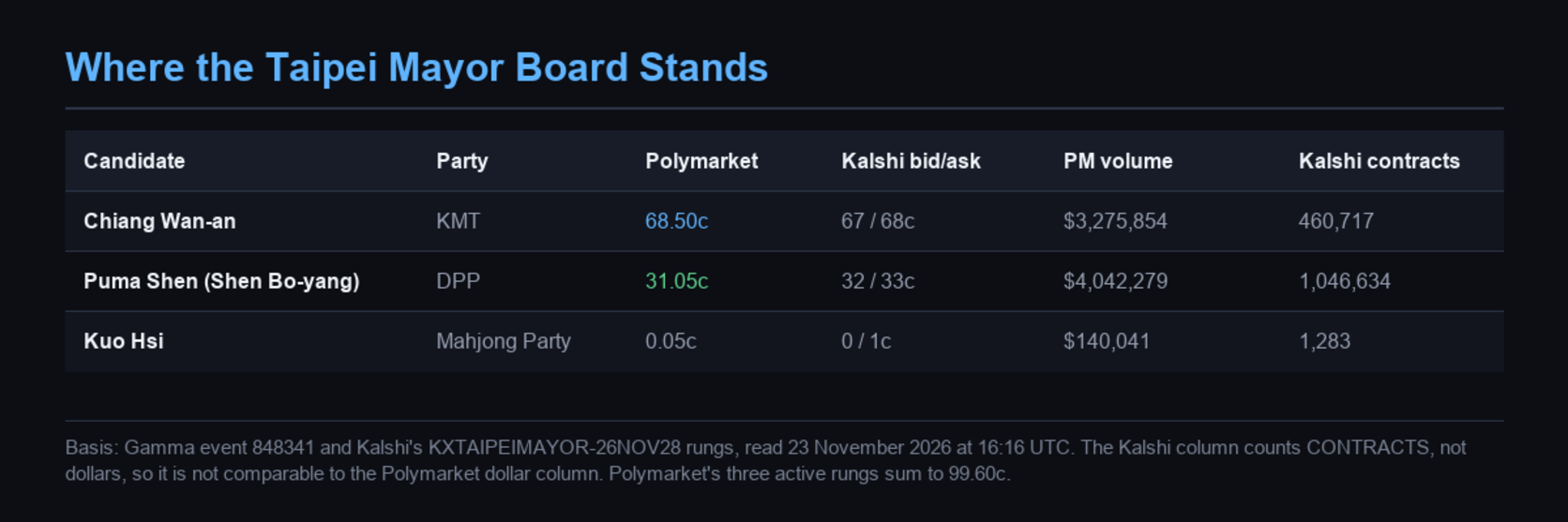
Both venues agree, and that is worth saying first because it is not always true. On the two rungs that carry real money the Taipei mayor election odds are within a cent and a half of each other across Polymarket and Kalshi, which is about as close as two unconnected order books get.
| Candidate | Party | Polymarket | Kalshi bid/ask | PM volume | Kalshi contracts |
|---|---|---|---|---|---|
| Chiang Wan-an | KMT | 68.50¢ | 67 / 68¢ | $3,275,854 | 460,717 |
| Puma Shen (Shen Bo-yang) | DPP | 31.05¢ | 32 / 33¢ | $4,042,279 | 1,046,634 |
| Kuo Hsi | Mahjong Party | 0.05¢ | 0 / 1¢ | $140,041 | 1,283 |
The detail that jumps out is in the last two columns. On both exchanges the challenger’s rung is the busier one: Shen has traded $4.04 million against Chiang’s $3.28 million, and 1,046,634 Kalshi contracts against 460,717, with open interest running 2.4 to 1 the same way. That is normal for a favourite-longshot pair, since the cheap side is where directional money goes, but the thicker book is the one on the losing price.
The event has turned over $7,458,174 since 14 August, with $1.23 million of resting liquidity. Live prices, refreshed every ten minutes, sit on our Taipei mayor odds page. Everything quoted in this article is frozen at the snapshot above.
Taiwan banned polls on 18 November. The market kept printing
Article 53 of the Civil Servants Election and Recall Act forbids publishing, reporting, commenting on or citing the result of any election opinion poll in the ten days before voting. Counting back from a 28 November ballot puts the start at 00:00 on 18 November, and the ban holds until polls close at 16:00 on election day. The Central Election Commission confirmed the window, warned that quoting a poll inside it is punishable by a fine, and noted it covers anything resembling a poll.
A prediction market on a blockchain is not an opinion poll and is not published in Taiwan, so none of this reaches it. The result is strange: for the six days before Taiwan’s most contested mayoral race in a generation, the only continuously updating public number about it has been a price set mostly by people who cannot vote in it.
| Date | Chiang | Shen | What was happening |
|---|---|---|---|
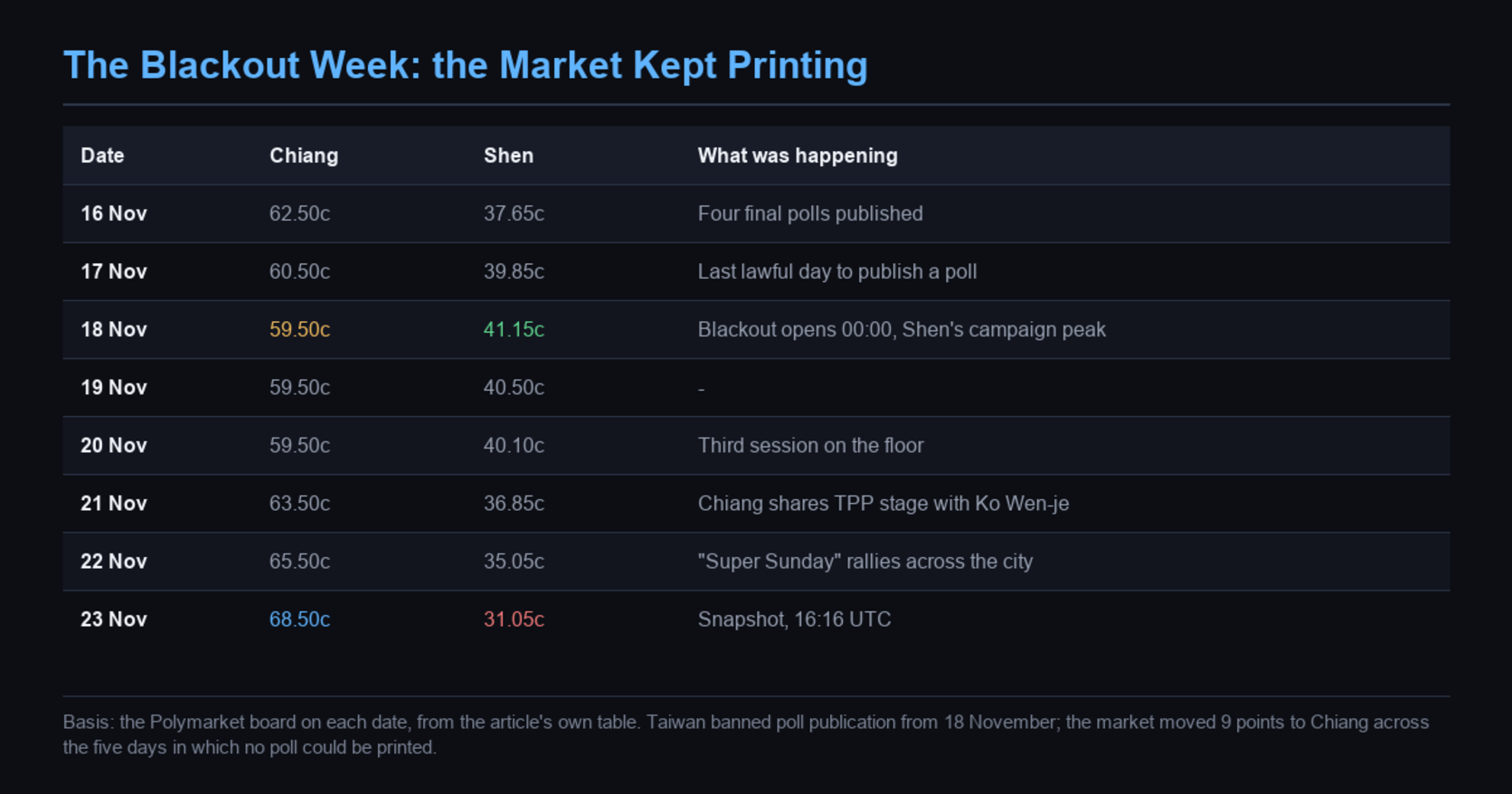
| 16 Nov | 62.50¢ | 37.65¢ | Four final polls published |
| 17 Nov | 60.50¢ | 39.85¢ | Last lawful day to publish a poll |
| 18 Nov | 59.50¢ | 41.15¢ | Blackout opens 00:00 — Shen's campaign peak |
| 19 Nov | 59.50¢ | 40.50¢ | — |
| 20 Nov | 59.50¢ | 40.10¢ | Third session on the floor |
| 21 Nov | 63.50¢ | 36.85¢ | Chiang shares TPP stage with Ko Wen-je |
| 22 Nov | 65.50¢ | 35.05¢ | “Super Sunday” rallies across the city |
| 23 Nov | 68.50¢ | 31.05¢ | Snapshot, 16:16 UTC |
Read down the Chiang column and the shape is unmistakable. He sat on 59.50¢ for three consecutive sessions — 18, 19 and 20 November — and then went 63.50, 65.50, 68.50. That is nine points in three days, in a stretch where, by law, not one new poll could be published to move anybody’s mind. Whatever is repricing this market, it is not survey data reaching the public.
The four final polls split 2-2, and the market sided against most of them
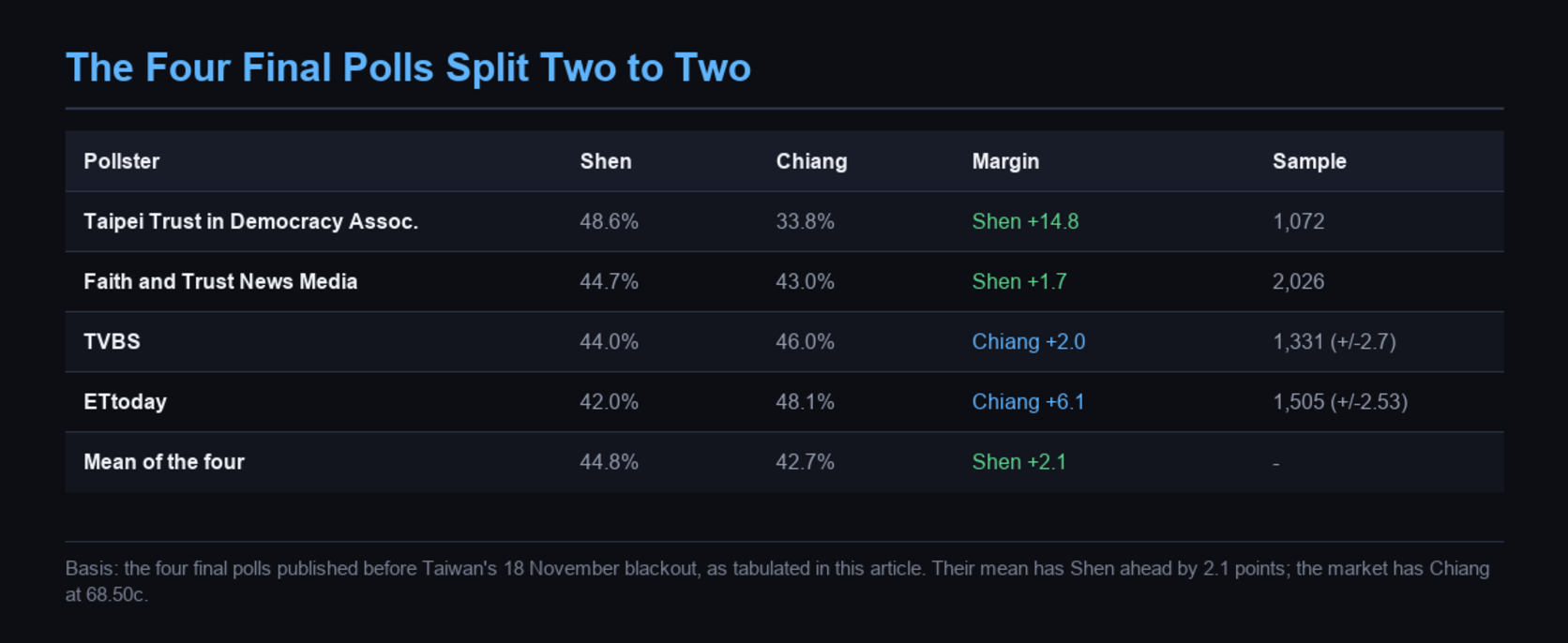
The last lawful polling is the right benchmark for any claim about the Taipei mayor election odds, so here it is in full. Four surveys were released on 16 November. Two had Shen ahead, two had Chiang ahead, and the spread between the most favourable and least favourable reading of the same race was 20.9 points.
| Pollster | Shen | Chiang | Margin | Sample |
|---|---|---|---|---|
| Taipei Trust in Democracy Assoc. | 48.6% | 33.8% | Shen +14.8 | 1,072 |
| Faith and Trust News Media | 44.7% | 43.0% | Shen +1.7 | 2,026 |
| TVBS | 44.0% | 46.0% | Chiang +2.0 | 1,331 (±2.7) |
| ETtoday | 42.0% | 48.1% | Chiang +6.1 | 1,505 (±2.53) |
| Mean of the four | 44.8% | 42.7% | Shen +2.1 | — |
Average them and Shen leads by 2.1 points. A Tamkang University scholar quoted at the time counted four of seven final polls showing Shen ahead, while cautioning that the methodologies differed — and they plainly did, since no sampling error explains a 14.8-point lead and a 6.1-point deficit in the same week.
Against that, the market pays Chiang 68.50¢, about 2.2 to 1. The case for the gap is structural rather than about survey quality. Chiang won Taipei in 2022 with just 42.29%, because the anti-DPP vote did not need to consolidate: TPP-backed Huang Shan-shan took 25.14% and the DPP’s Chen Shih-chung roughly 32%. In 2026 no TPP candidate is standing in Taipei at all, and if even half that bloc moves to Chiang he is comfortable. That is the question rather than the answer: whether a bloc transfers is exactly what polls exist to measure, and for ten days nobody may measure it in public.
What changed on 21 November
One dated event sits exactly on the inflection. On the evening of Saturday 21 November, Chiang appeared at a TPP rally outside Taipei City Hall and shared the stage with Ko Wen-je, the party’s founder and Taipei’s mayor from 2014 to 2022. Ko had been noncommittal beforehand, saying his own party’s candidates came first, and he is appealing a 17-year sentence handed down in March on bribery and other charges.
That is the clearest available signal that 2022’s 25% Taipei bloc is being pointed at the incumbent, and it is the day the 59.50¢ floor broke. Chiang had spent the week courting the party, campaigning with TPP chairman Huang Kuo-chang on 15 November and with its mayoral candidate Andy Chiu — which a Taipei Times editorial noted came at the expense of his own council candidates.
Two cautions, and they matter more than the correlation does. The hourly series (interval=1d&fidelity=60) has Chiang at 69.50¢ at 17:00 UTC on 22 November against 68.50¢ at the snapshot, so he has drifted slightly down over the last day and the three-day move is not one continuous surge. And the blackout cuts both ways: no poll can corroborate the Ko effect, and none can rule it out. We name a coincidence of dates because it is the only documented event in the window, not because the market has said why it moved.
From 0.65¢ to 41¢: the campaign in nine dates
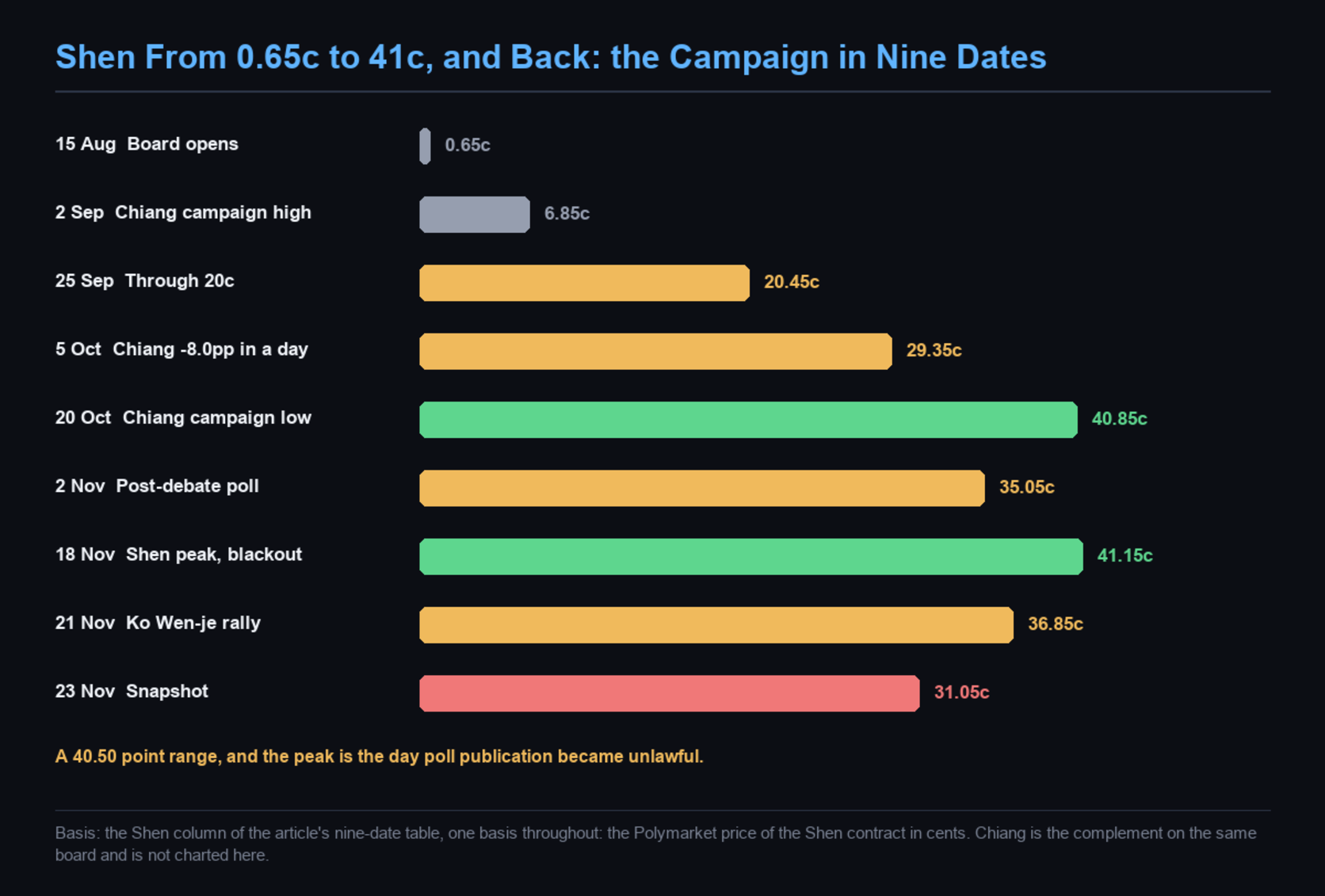
The blackout fortnight is the end of a long story. When this board opened on 14 August, Shen was priced at six-tenths of a cent — the DPP had named him in May, but the market had not noticed, or did not believe it. He peaked 95 days later at 41.15¢, a 63-fold repricing.
| Date | Chiang | Shen | Note |
|---|---|---|---|
| 15 Aug | 89.50¢ | 0.65¢ | Board opens |
| 2 Sep | 93.50¢ | 6.85¢ | Chiang's campaign high |
| 25 Sep | 80.00¢ | 20.45¢ | Shen through 20¢ for the first time |
| 5 Oct | 71.50¢ | 29.35¢ | Biggest single-day move: Chiang −8.0pp |
| 20 Oct | 59.50¢ | 40.85¢ | Chiang's campaign low |
| 2 Nov | 65.50¢ | 35.05¢ | Post-debate poll puts Shen at 52.6% |
| 18 Nov | 59.50¢ | 41.15¢ | Shen's peak; blackout opens |
| 21 Nov | 63.50¢ | 36.85¢ | Ko Wen-je rally |
| 23 Nov | 68.50¢ | 31.05¢ | Snapshot |
Note what the market did with the best poll Shen ever got. A Strategy and Public Research Institute survey after the first debate put him at 52.6% against Chiang’s 35.3%. On the day it circulated Shen’s rung traded at 35.05¢, and Chiang went up four points over the following week. A market that declines to follow a 17-point lead in early November is at least consistent when it declines to follow a 2.1-point one in late November.
Two venues, six candidates, three names and 27 blanks
This is where the two books stop agreeing. Six candidates are registered for Taipei. Kalshi lists all six. Polymarket lists three by name plus 27 inactive rungs labelled “Candidate A” through “Candidate Z” and “Other”, created on 14 August and never traded — which is why the board reports 30 markets and three prices.
| Candidate | Party | Kalshi | Polymarket |
|---|---|---|---|
| Chiang Wan-an | KMT (incumbent) | Yes — CWAN | Yes |
| Shen Bo-yang | DPP | Yes — SPY | Yes, as “Puma Shen” |
| Kuo Hsi | Taiwan Mahjong Greatest | Yes — KHSI | Yes |
| Hsiao Wen-kan | FoRmosan SoR | Yes — HWK | No |
| Tang Hsin-min | Third Force alliance | Yes — THM | No |
| Lin Chih-cheng | Independent | Yes — LCC | No |
The name mismatch is the trap worth flagging. Puma Shen and Shen Bo-yang are one man — Puma is the name he uses in English and the one Polymarket prints; Kalshi uses the romanised Chinese. Anybody comparing the two books by eye can read that as two different candidates and conclude the DPP vote is split when it is not.
Shen is also why this municipal race belongs on a geopolitics site. He founded Doublethink Lab, which researches Chinese information operations, and co-founded the Kuma Academy civil defence group. Beijing’s Taiwan Affairs Office sanctioned him in 2024, barred him from China, Hong Kong and Macau, later designated him a diehard separatist, and Chongqing public security authorities opened a secession investigation into him. One of the two people on this ballot is under criminal investigation by the government across the strait, which is a different kind of mayoral race from the one the price alone suggests — the same cross-strait frame we track in our China-Taiwan invasion odds analysis.
Kalshi’s margin ladder contradicts itself
Kalshi runs something Polymarket does not: a nine-rung ladder on how big Chiang’s win is, from 2% to 18%. A ladder like this should fall monotonically, because each rung is a strict subset of the one below it. Anyone who wins by 14 points has necessarily won by 12. This one does not fall monotonically.
| Rung | Bid | Ask | Last | Lifetime | 24h |
|---|---|---|---|---|---|
| Chiang by ≥2% | 57¢ | 65¢ | 65¢ | 69 | 69 |
| Chiang by ≥4% | 46¢ | 55¢ | — | 0 | 0 |
| Chiang by ≥6% | 37¢ | 46¢ | — | 0 | 0 |
| Chiang by ≥8% | 28¢ | 37¢ | — | 0 | 0 |
| Chiang by ≥10% | 19¢ | 29¢ | — | 0 | 0 |
| Chiang by ≥12% | 7¢ | 11¢ | 7¢ | 1,888 | 1,876 |
| Chiang by ≥14% | 9¢ | 14¢ | 9¢ | 300 | 0 |
| Chiang by ≥16% | 6¢ | 15¢ | 34¢ | 135 | 0 |
| Chiang by ≥18% | 2¢ | 12¢ | 7¢ | 532 | 0 |
The ≥14% rung bids 9¢ while the ≥12% rung bids 7¢, and its ask is 14¢ against the easier rung’s 11¢. The harder outcome is quoted above the easier one, which cannot be right in both places at once.
It is not an arbitrage, and it is worth being precise about why. To profit you would buy the easier rung and sell the harder one: buy ≥12% at its 11¢ ask, sell ≥14% at its 9¢ bid, and you have paid 2¢ for a position that can never lose. The spread eats it. This is an ordering inconsistency in a thin book, not free money — which is what you would expect when five of nine rungs have never traded and only one has seen a contract in 24 hours. The ≥16% rung’s last print of 34¢ against a 6/15 quote tells the same story: a stale mark on 135 lifetime contracts, not a price. We found the same pattern on Kalshi’s midterm ladders, and the discriminator is always volume rather than the quote.
The ladder does say one useful thing: its ≥2% rung at 57/65¢ against a 67/68¢ winner price leaves only a few cents on Chiang winning by under two points. This is not priced as a photo finish.
The referendum on the same ballot needs 5,000,523 yes votes
Voters get a second paper on Saturday: a KMT-proposed, TPP-backed referendum asking whether the government should use nuclear power to boost the economy and abolish the “nuclear-free homeland” policy. Kalshi quotes it at 79/85¢ to pass, on 17.83 lifetime contracts — an indication, not a price.
The interesting part is the threshold, because Taiwan’s Referendum Act does not just require more yes votes than no votes. Yes votes must also reach a quarter of the entire electorate — a fixed bar of 5,000,523 votes, regardless of how many people turn up. That is what killed the near-identical question 15 months ago.
| Quantity | Figure |
|---|---|
| Yes votes needed (¼ of electorate) | 5,000,523 |
| Implied electorate | ~20.0 million |
| Aug 2025 Maanshan yes votes | ~4.34 million |
| Aug 2025 yes share of valid votes | 74% |
| Aug 2025 shortfall against the bar | ~660,000 |
| Aug 2025 turnout (standalone vote) | 29.5% |
| 2022 local-election turnout | ~59.6% |
| Yes share of a 59.6% turnout needed to clear the bar | ~42% |
Read the last two rows together and the 2026 question looks very different from the 2025 one. In August 2025 the yes side won 74% of valid votes and still lost, because a standalone referendum drew 29.5% turnout. Attaching the same argument to a local election that pulled about 59.6% in 2022 roughly doubles the denominator, so the yes side needs only about 42% of those who show up rather than 85%. That is why a price near 80¢ is coherent even though the proposition has failed before.
Two caveats. A yes vote is a “major policy” vote and is not self-executing: it obliges the authorities to act and bars them from reversing course for two years, but the nuclear-free provisions sit in the Basic Environment Act and the Climate Change Response Act, and only the legislature can remove them. And the 2021 and 2025 nuclear referendums both failed, so the base rate here is zero for three.
What would have to happen in five days
For Shen to come back from 31¢ nothing needs to be revealed, because on the polling evidence he is not behind. He needs the 2022 TPP bloc not to transfer, and the turnout no Taipei DPP campaign has managed in nearly three decades. His campaign runs a three-day motorcade through all 12 districts from 24 to 26 November. For Chiang, the market has already priced the consolidation; the risk is that it is pricing an endorsement from a politician appealing a 17-year sentence as worth a clean 25%.
One number to watch that is not a poll: the island-wide board. Both venues have the KMT holding most of the 22 mayor and magistrate seats — 77.50¢ on Polymarket, 79/81¢ on Kalshi — against a 2022 baseline of KMT 14, DPP 5, TPP 2 and one independent. Yet Polymarket has the DPP ahead in New Taipei, where Su Chiao-hui pays 52.5¢ against the joint KMT-TPP candidate Lee Shu-chuan at 48¢. A night where the KMT keeps the island and loses New Taipei is a coherent outcome both books are pricing at once, and it is the clearest sign that neither is simply reading a national swing.
Results start after 16:00 Taipei time on 28 November, which is 08:00 UTC. Kalshi’s rungs can settle early on a media-call consensus with a 30-minute timer, though their formal expiry runs to 2027; Polymarket’s board ends 29 November, with an “Other” backstop out to 30 June 2027 if no winner is known. For how we read any of these prices, our methodology page sets out the rules.
Related articles
- Will China invade Taiwan? What the 2026 odds actually price
- Polymarket vs Kalshi 2026 midterms odds: four books, one question
- Polymarket vs Kalshi: the Venezuela leader boards compared
- Polymarket vs Kalshi French election odds for 2027
- Israel election odds 2026: the next prime minister board
- How GeoOdds reads prices, volume and resolution rules
New to prediction markets?
New traders get a $20 bonus
Deposit $10 on Polymarket and get a $20 trading bonus to put behind your first call.
See the live Taipei mayor board on Polymarket →New Polymarket users only. Bonus is trading credit, expires 30 days after it lands, and terms are set by Polymarket — check the current offer at signup. 18+. Fee-free markets. GeoOdds earns a commission on signups through this link.
Frequently asked questions
What are the Taipei mayor election odds for 2026?
At 16:16 UTC on 23 November 2026, Polymarket pays 68.5¢ that Chiang Wan-an of the KMT wins re-election on 28 November, against 31.05¢ for the DPP's Puma Shen. Kalshi quotes 67-68¢ for Chiang and 32-33¢ for Shen. The Polymarket board has traded $7.46 million since 14 August.
Why do the Taipei polls and the prediction market disagree?
The four polls published on 16 November split two apiece and averaged Shen ahead by 2.1 points, while the market pays Chiang about 2.2 to 1. The market is pricing a consolidated anti-DPP vote: Chiang won in 2022 with only 42.29% because the TPP-backed candidate took 25.14%, and no TPP candidate is standing in Taipei in 2026. Whether that bloc transfers is the open question, and no poll may legally test it.
Is it legal to publish opinion polls in Taiwan right now?
No. Article 53 of the Civil Servants Election and Recall Act bars publishing, reporting, commenting on or citing any election poll in the ten days before voting — here from 00:00 on 18 November to 16:00 on 28 November, Taipei time. The Central Election Commission has said quoting a poll in that window is punishable by a fine, and the ban covers material that merely has the appearance of a poll.
Who is Puma Shen, the DPP candidate for Taipei mayor?
Shen Bo-yang, who goes by Puma Shen, is a DPP legislator who founded Doublethink Lab, which researches Chinese information operations, and co-founded the Kuma Academy civil defence group. Beijing's Taiwan Affairs Office sanctioned him in 2024 for what it called inciting separatism and later called him a diehard separatist, and Chongqing opened a secession investigation into him. The DPP named him in May 2026.
Does Kalshi list Taipei mayor markets?
Yes — four Taiwan events covering this ballot: a six-candidate Taipei winner market, a three-way island-wide party market, a nine-rung ladder on Chiang's margin of victory, and the nuclear referendum. Kalshi lists all six registered Taipei candidates where Polymarket names three, and its prices track Polymarket's within about a cent and a half on the two that matter.
What is being decided in Taiwan's 2026 local elections?
The 28 November ballot fills 22 city mayor and county magistrate seats, 919 councillor seats, 204 township mayors and indigenous district chiefs, 2,139 township representatives and 7,748 village chiefs. The KMT took 14 of the 22 top seats in 2022, the DPP five, the TPP two and an independent one — the baseline both venues price the island-wide market against.
Will Taiwan's nuclear referendum pass on 28 November?
Kalshi quotes it at 79-85¢ on 17.83 lifetime contracts, so treat that as an indication, not a price. Passage needs more yes than no votes and yes votes reaching a quarter of the electorate: 5,000,523. The near-identical August 2025 Maanshan referendum won 74% of valid votes and still failed by roughly 660,000 on 29.5% turnout. Sharing a ballot that drew about 59.6% turnout in 2022 is what changes the arithmetic.
Sources: prices, volume and resolution text from the Polymarket Gamma and CLOB public APIs (event 848341and event 96786 (97 daily closes for markets 3580932 and 3580933), and from the Kalshi public markets API (six KXTAIPEIMAYOR rungs, three KXTAIWANLOCAL rungs, nine KXTAIPEIMAYORMOVD rungs and KXTAIWANNUCLEARREF-26NOV28), read at 23 November 2026, 16:16 UTC; the blackout window from the Central Election Commission’s announcement as reported by Taiwan News, with the statutory basis in Article 53 (Central Election Commission); the four final polls and the referendum threshold from the Taipei Times of 17 and 21 November; the Ko Wen-je rally and final weekend from Focus Taiwan; and the offices contested and 2022 baseline from the 2026 Taiwanese local elections record. Prices move; the figures above are a frozen snapshot and nothing here is financial, legal or investment advice.