
Israel Election Odds 2026: Who Replaces Netanyahu?
Published 11 September 2026 · Prices frozen 11 September 2026, 21:20 UTC
Key takeaways
- The market has a favourite, and it is not Netanyahu. Polymarket prices Gadi Eisenkot at 52.2¢ to be Israel’s next prime minister against 28.5¢ for Benjamin Netanyahu, with Naftali Bennett a distant third at 7.5¢.
- The seat race repriced violently. The premiership race barely moved. In a month Yashar’s chance of winning the most seats rose 17.5 points and Likud’s fell 13.5, while Netanyahu’s premiership odds moved 2 points and Eisenkot’s moved 1.
- Coming first is worth nothing without 61. The five polls published on 10 September left the Netanyahu bloc on an average of 53.6 seats and the opposition on 53.4, with Arab parties holding the balance.
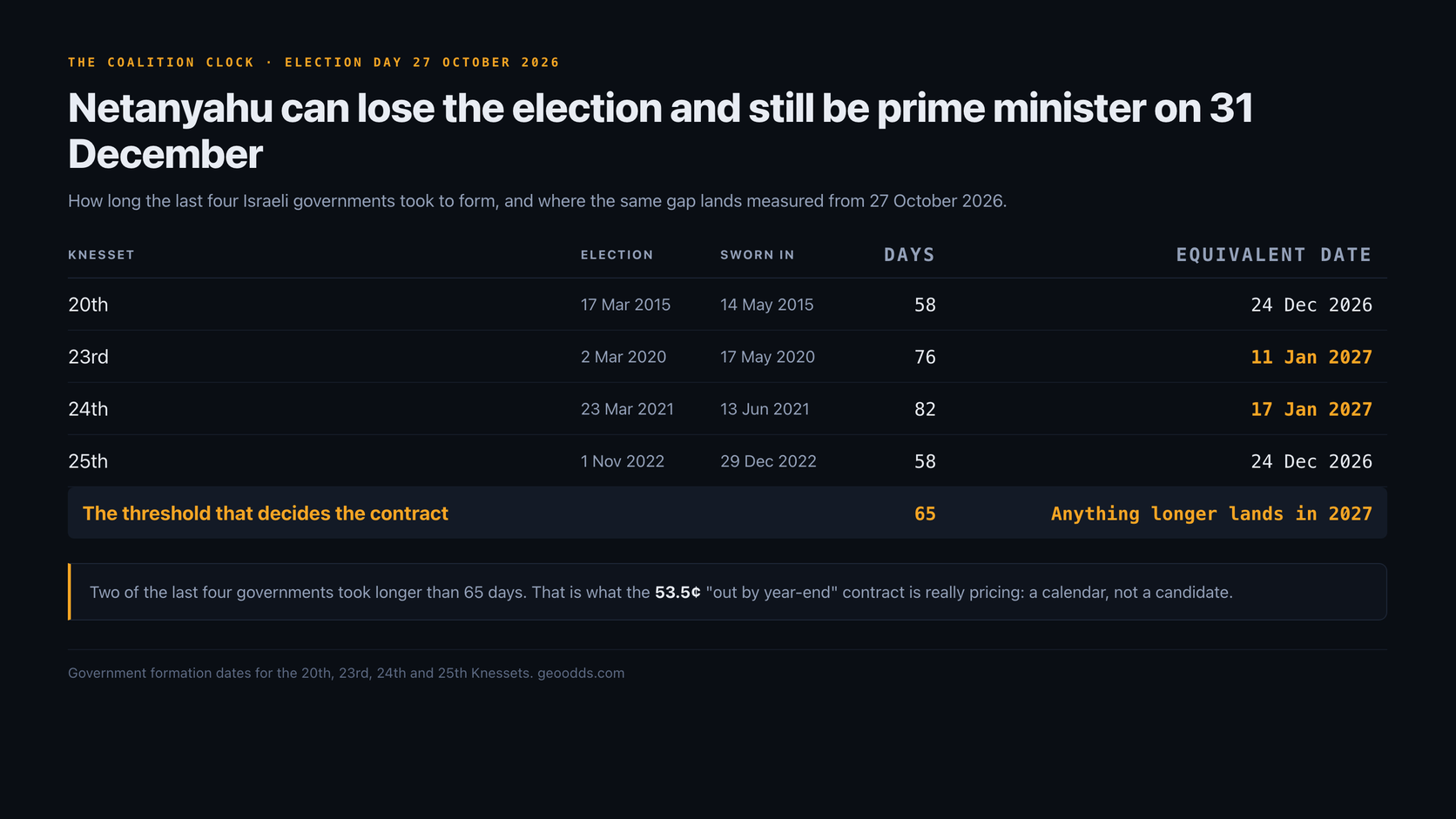
- Netanyahu can lose the election and still be prime minister on 31 December. The last four Israeli governments took 58, 76, 82 and 58 days to form. From 27 October, anything over 65 days lands in 2027 — and that is what the 53.5¢ “out by year-end” contract is really pricing.
- Kalshi lists the same question and nobody trades it. All twelve candidates on its next-prime-minister ladder showed no bid, no ask and zero open interest.

Benjamin Netanyahu has been prime minister of Israel for all but eighteen months of the last seventeen years, and seven weeks from now the country votes on whether that continues. The Israel election odds for 2026 put real money on the answer: $124m of it on whether Netanyahu is out by 31 December, another $37m on who is sworn in after the 27 October vote. Most coverage treats those as the same bet. They are not, and the gap between them is the most tradeable thing on the board. We pulled every open Israeli contract on Polymarket, diffed a month of CLOB price history, checked Kalshi’s competing ladder and read the statutory coalition clock — and the market’s central claim turns out to be about a calendar, not a candidate.
Where the Israel election odds stand today
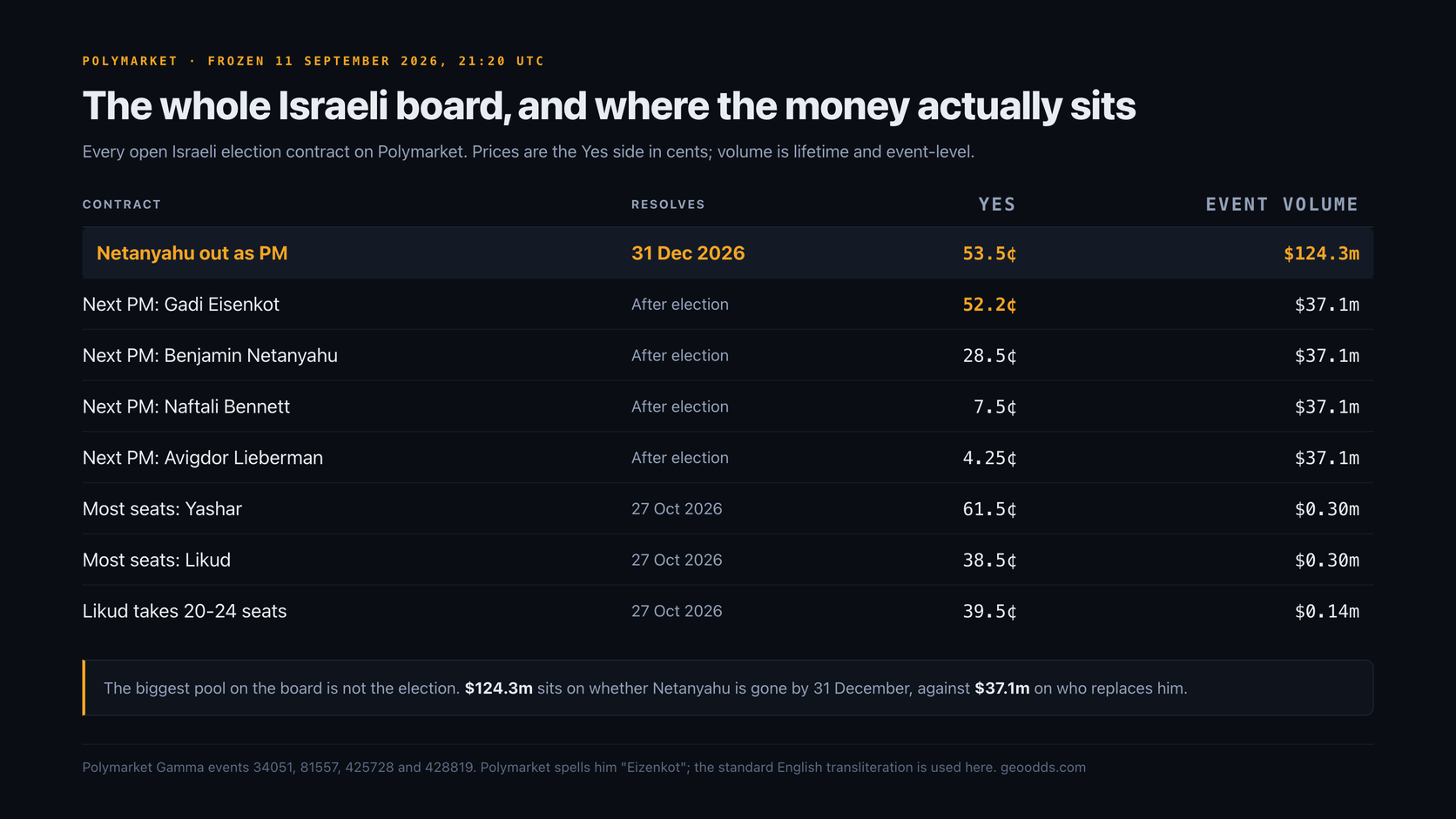
Four separate Polymarket contracts price this election, and they are almost never shown together. One asks whether Netanyahu is gone by year-end. One asks who is sworn in next. One asks which party takes the most seats. One asks how many seats Likud takes. Put on a single board, they describe a market that expects Netanyahu to lose and is far less sure he leaves on schedule.
| Contract | Resolves | Yes | Event volume |
|---|---|---|---|
| Netanyahu out as PM | 31 Dec 2026 | 53.5¢ | $124.3m |
| Next PM: Gadi Eisenkot* | After election | 52.2¢ | $37.1m |
| Next PM: Benjamin Netanyahu | After election | 28.5¢ | $37.1m |
| Next PM: Naftali Bennett | After election | 7.5¢ | $37.1m |
| Next PM: Avigdor Lieberman | After election | 4.25¢ | $37.1m |
| Most seats: Yashar | 27 Oct 2026 | 61.5¢ | $0.30m |
| Most seats: Likud | 27 Oct 2026 | 38.5¢ | $0.30m |
| Likud takes 20–24 seats | 27 Oct 2026 | 39.5¢ | $0.14m |
Two things jump out. The first is the liquidity gradient: the premiership question carries $37m and the most-seats market carries $302,000. A four-hundred-fold difference in stake size is a four-hundred-fold difference in how seriously you should take a two-point move. The second is that no candidate outside the top four clears a cent — Itamar Ben Gvir sits at 0.5¢, Benny Gantz at 0.1¢, and Yair Lapid at 0.05¢. For a country famous for coalition surprises, the field is unusually closed.
The seat race moved 17 points. The premiership race didn’t.
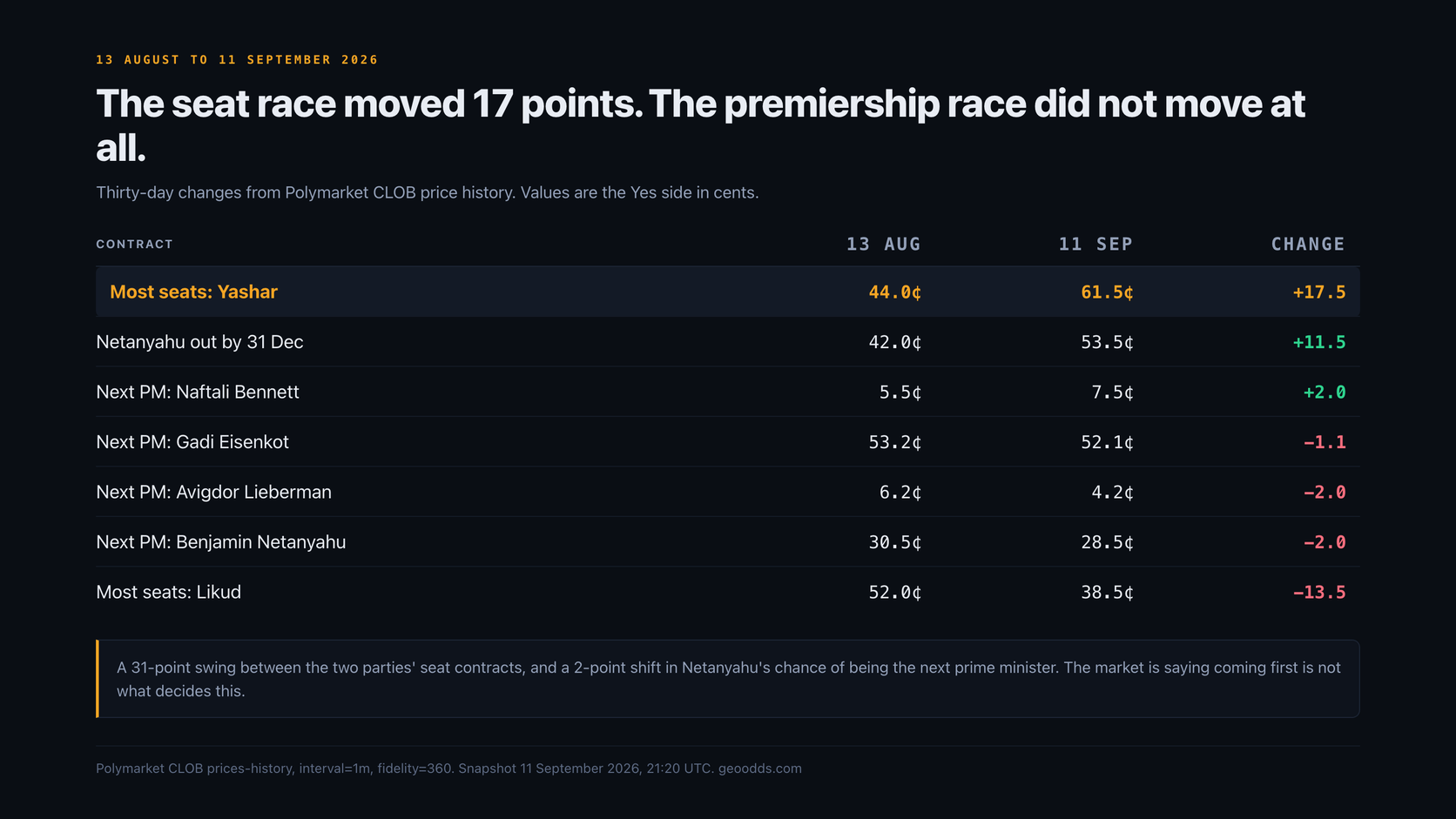
Diff the CLOB price history from 13 August to 11 September and the month splits cleanly in two. The contracts about seats were repriced hard. The contracts about power were left almost untouched.
| Contract | 13 Aug | 11 Sep | Change |
|---|---|---|---|
| Most seats: Yashar | 44.0¢ | 61.5¢ | +17.5 |
| Netanyahu out by 31 Dec | 42.0¢ | 53.5¢ | +11.5 |
| Next PM: Naftali Bennett | 5.5¢ | 7.5¢ | +2.0 |
| Next PM: Gadi Eisenkot | 53.2¢ | 52.1¢ | −1.1 |
| Next PM: Avigdor Lieberman | 6.2¢ | 4.2¢ | −2.0 |
| Next PM: Benjamin Netanyahu | 30.5¢ | 28.5¢ | −2.0 |
| Most seats: Likud | 52.0¢ | 38.5¢ | −13.5 |
A 31-point swing in the relative standing of the two largest parties produced a 2-point change in the odds on who governs. If you think those are the same question, that is incoherent. It is only coherent if the market believes something specific: that in Israel, the identity of the largest party is close to irrelevant to the identity of the prime minister. That belief happens to be correct, and it is where most English-language coverage of this election goes wrong.
Why 61 seats beats first place in Israeli politics
The Knesset has 120 seats, elected by closed-list proportional representation in a single nationwide constituency with a 3.25% threshold. No party has ever won 61 on its own. What the president does after the count is hand the mandate to whichever member of the Knesset looks likeliest to command a majority — which is a question about alliances, not about who finished first.
Israeli history is emphatic on the point. In 2009 Kadima won 28 seats to Likud’s 27 and Netanyahu formed the government. In 2021 Likud won 30, more than double the next party, and Naftali Bennett — whose Yamina had seven — became prime minister. Finishing first bought neither Tzipi Livni nor Netanyahu anything on its own.
The merger deadline that repriced Likud
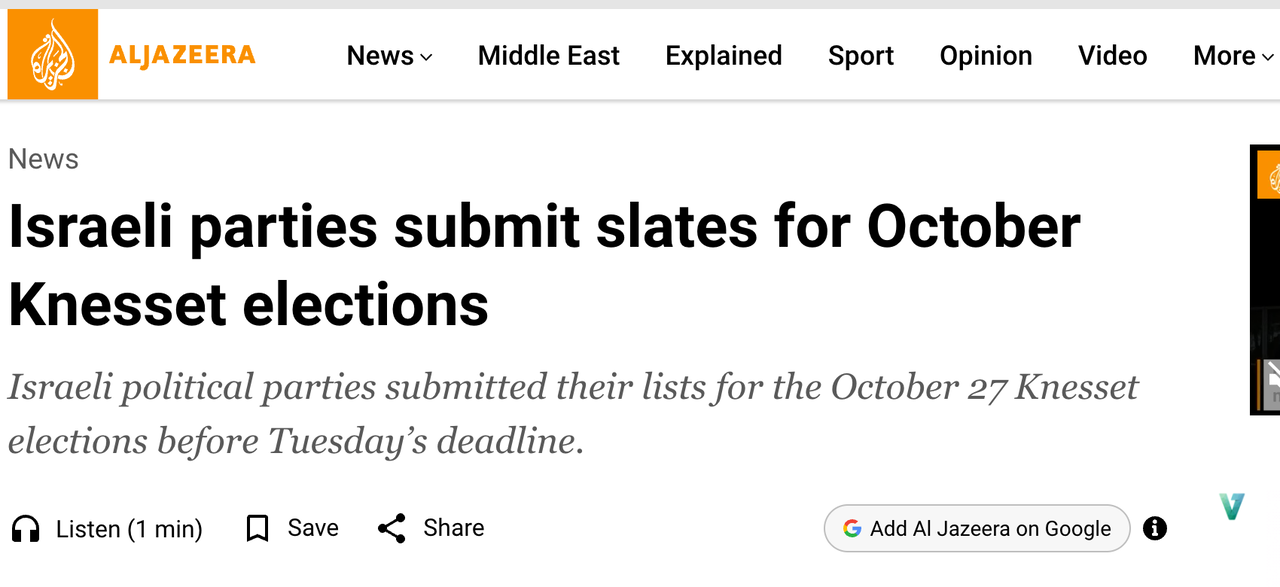
The seat market’s move was not drift. It was a single event with a date on it. Candidate lists had to be filed by 8 September, and 38 lists went in with none of the mergers anybody expected. On the right, Netanyahu had pushed Bezalel Smotrich’s Religious Zionism to combine with either Itamar Ben Gvir’s Otzma Yehudit or Ofer Winter’s People of Israel. All three filed separately. On the centre-left, Eisenkot’s Yashar and Bennett’s B’Yachad filed separately too.
With a 3.25% threshold — about four seats — every party that runs alone and misses it burns its voters’ ballots entirely. Religious Zionism is polling on the threshold. Winter’s list is polling just above it. Benny Gantz’s Blue and White is projected to miss. That risk is concentrated on the right, which is why Likud’s seat distribution shifted down rather than up.
| Likud seats | 13 Aug | 11 Sep | Change |
|---|---|---|---|
| Under 20 | 20.2¢ | 14.8¢ | −5.4 |
| 20–24 | 31.0¢ | 39.5¢ | +8.5 |
| 25–29 | 32.0¢ | 28.0¢ | −4.0 |
| 30–34 | 15.0¢ | 16.0¢ | +1.0 |
| 35 or more | 4.0¢ | 4.0¢ | 0.0 |
The ladder tightened around a mediocre result rather than collapsing. The tails both thinned, the 20–24 band absorbed 8.5 points, and the modal outcome is now a Likud that is smaller than in 2022 but still large. Note what that does not say: a 22-seat Likud inside a 61-seat bloc governs, and a 27-seat Likud outside one does not.
The polls behind the Israel election odds — and the house effect
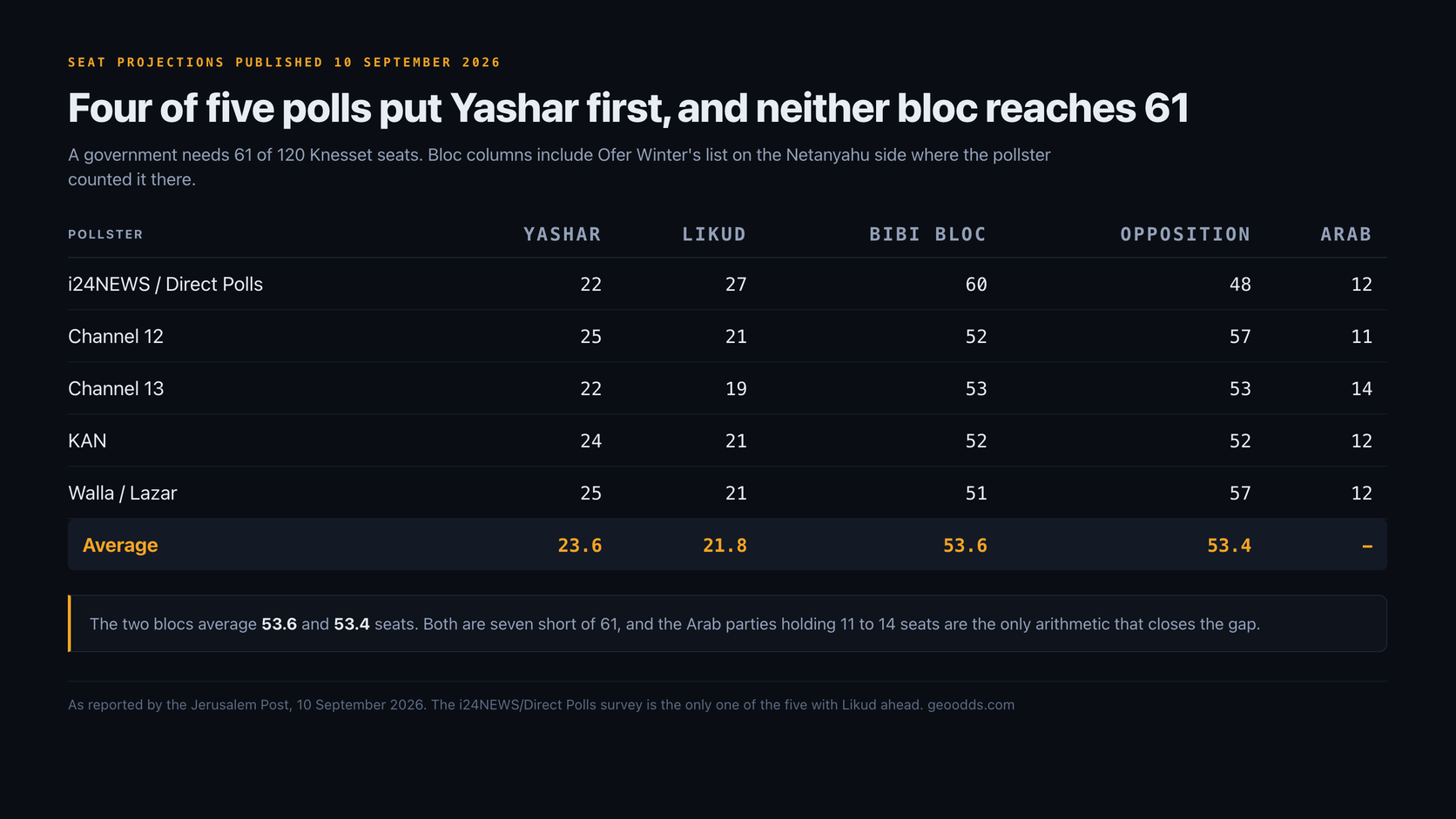
Five seat polls landed on 10 September. Four of them put Yashar first.
| Pollster | Yashar | Likud | Bibi bloc | Opposition | Arab |
|---|---|---|---|---|---|
| i24NEWS / Direct Polls | 22 | 27 | 60 | 48 | 12 |
| Channel 12 | 25 | 21 | 52 | 57 | 11 |
| Channel 13 | 22 | 19 | 53 | 53 | 14 |
| KAN | 24 | 21 | 52 | 52 | 12 |
| Walla / Lazar | 25 | 21 | 51 | 57 | 12 |
| Average | 23.6 | 21.8 | 53.6 | 53.4 | — |
Read the bloc columns, not the party columns. The average leaves the Netanyahu bloc on 53.6 and the opposition on 53.4 — a 0.2-seat gap, in polls with a ±4-seat error bar — with 11 to 14 Arab seats sitting outside both. Neither side reaches 61 without a partner it has spent the campaign refusing to name.
The preferred-prime-minister polls are messier, and the mess is the finding. Channel 14’s Filber polls have had Netanyahu ahead in every single reading since late August. Every other house has had Eisenkot ahead.
| Pollster | Date | Netanyahu | Eisenkot |
|---|---|---|---|
| Filber / Channel 14 | 27 Aug | 56% | 44% |
| Filber / Channel 14 | 30 Aug | 54% | 46% |
| Filber / Channel 14 | 3 Sep | 54% | 46% |
| Filber / Channel 14 | 7 Sep | 56% | 44% |
| Filber / Channel 14 | 9 Sep | 53% | 47% |
| Midgam / Channel 12 | 9 Sep | 38% | 42% |
| Lazar / Maariv | 9–10 Sep | 38% | 50% |
A 12-point spread between houses polling the same week is a house effect, not noise. Channel 14 is an openly pro-Netanyahu outlet, and its two-way forced choice drops the “neither” option that Midgam’s 13% and Lazar’s 12% undecided both keep. If you are pricing this market off a single poll, the poll you picked matters more than the week it was taken.
Why Netanyahu can lose and still be PM on 31 December
Here is the gap worth understanding. Netanyahu out by 31 December prices at 53.5¢. Netanyahu being the next prime minister prices at 28.5¢. If he is the next prime minister, he never leaves — so the two should sum to roughly 100. They sum to 82. The missing 18 points are worlds where Netanyahu loses the election and is still in office on New Year’s Eve, because Israel’s outgoing government stays on in a caretaker capacity until a successor is sworn in.
The Israel Democracy Institute sets out the clock. After consultations the president tasks one member of the Knesset with forming a government: 28 days, extendable by 14 on request. If that fails, a second candidate gets 28 days with no extension. If that fails, any 61 members can nominate someone within a 21-day window before the Knesset dissolves itself. The statutory path alone runs to 91 days, before you add the week or two between polling day and the handover of the mandate.
| Knesset | Election | Sworn in | Days | Equivalent date |
|---|---|---|---|---|
| 20th | 17 Mar 2015 | 14 May 2015 | 58 | 24 Dec 2026 |
| 23rd | 2 Mar 2020 | 17 May 2020 | 76 | 11 Jan 2027 |
| 24th | 23 Mar 2021 | 13 Jun 2021 | 82 | 17 Jan 2027 |
| 25th | 1 Nov 2022 | 29 Dec 2022 | 58 | 24 Dec 2026 |
Sixty-five days is the line. Form a government in 65 days from 27 October and the handover happens on 31 December; take 66 and Netanyahu is still prime minister when the contract resolves. Two of the last four governments came in under that line and two did not — a 50% base rate against a market at 53.5¢. That is close enough that the contract is best read as a bet on coalition speed rather than on the election result, and the 2026 arithmetic points at a slow one: nobody reaches 61 without a partner they have publicly refused.
Kalshi lists the same question and nobody trades it
Kalshi’s KXNEXTISRAELPM-45JAN01 asks who will succeed Netanyahu as prime minister before 1 January 2045, across twelve named candidates including Eisenkot, Bennett, Lieberman and Smotrich. A companion event, KXISRDEFMIN-30, asks who becomes defence minister after the election. On 11 September 2026 every market in both events returned no bid, no ask, no volume and no open interest.
We will not print a cross-exchange gap built on an empty book, and our matching methodology hides the Kalshi module whenever the liquidity does not support it. It is worth noting that the two questions are not the same anyway: a 2045 horizon covers every Israeli prime minister for the next two decades, while Polymarket’s contract resolves on the person sworn in after this election. The informative price exists on exactly one venue.
What could move these odds before 27 October
Three dates and one sentence. The first date is 27 September, when the Central Elections Committee finalises the candidate lists — the last moment for a technical disqualification or a withdrawal to reshape the threshold maths. The second is whatever day the final pre-election polls land, since Israel’s election-silence rules stop poll publication from the end of the Friday before polling day, leaving the market to trade the closing stretch on the last numbers anyone published. The third is 27 October itself, which resolves the Likud seat ladder and the most-seats market while leaving the premiership question wide open for months.
The sentence is Eisenkot’s. He has set three conditions for any coalition partner — recognition of Israel as a Jewish and democratic state, endorsement of Independence Day, and a commitment to military or national service — which as the Arab Center Washington DC reads them exclude three Arab parties and leave the door open to Ra’am. Ra’am sat in the Bennett-Lapid coalition from June 2021, so the precedent exists. If Eisenkot says the word out loud before polling day, his premiership contract should move — and so, in the opposite direction, should the year-end Netanyahu contract.
Related on GeoOdds
- Israel & Gaza odds hub — every active Israeli market in one place
- Netanyahu out by 31 December — live odds and chart
- Next prime minister of Israel — live candidate probabilities
- Israeli legislative election winner — live party odds
- Israel closes its airspace — live probability
- Polymarket vs Kalshi: Venezuela leader odds — the same cross-exchange method
- Strait of Hormuz reopening odds — the regional backdrop
New to prediction markets?
New traders get a $20 bonus
Deposit $10 on Polymarket and get a $20 trading bonus to put behind your first call.
See the Israel election markets on Polymarket →New Polymarket users only. Bonus is trading credit, expires 30 days after it lands, and terms are set by Polymarket — check the current offer at signup. 18+. Fee-free markets. GeoOdds earns a commission on signups through this link.
Frequently asked questions
When is the 2026 Israeli election?
Tuesday 27 October 2026, for all 120 seats of the 26th Knesset. The 25th Knesset ran its full term and dissolved on 17 July 2026, which makes 27 October the latest date the vote could legally have been held. Candidate lists were filed by the 8 September deadline and the Central Elections Committee finalises them on 27 September.
Who is favourite to be Israel's next prime minister on prediction markets?
Gadi Eisenkot, the former IDF chief of staff who now leads the Yashar party. Polymarket priced him at 52.2¢ on 11 September 2026 against 28.5¢ for Benjamin Netanyahu, 7.5¢ for Naftali Bennett and 4.25¢ for Avigdor Lieberman. No other named candidate traded above 1¢.
What odds do markets give Netanyahu leaving office in 2026?
Polymarket priced Netanyahu being out as prime minister by 31 December 2026 at 53.5¢ on 11 September, up from 42¢ a month earlier. That contract resolves Yes on an announced resignation or removal by year-end, so it is a question about the coalition-formation calendar as much as about the election result.
Why do the seat odds and the prime minister odds disagree?
Because winning the most seats does not make you prime minister in Israel. A government needs the confidence of 61 of 120 members of the Knesset, so the premiership is decided by which leader can assemble a bloc. Between 13 August and 11 September the market moved Yashar's chance of winning the most seats up 17.5 points and Likud's down 13.5, while Netanyahu's chance of being the next prime minister moved just 2 points.
Which party is projected to win the most seats in the 2026 Knesset election?
Polling published on 10 September 2026 put Yashar first in four of five surveys, averaging 23.6 seats to Likud's 21.8. The exception was i24NEWS/Direct Polls, which had Likud on 27 to Yashar's 22. Polymarket priced Yashar at 61.5¢ and Likud at 38.5¢ to take the most seats.
Can Eisenkot form a government without the Arab parties?
On current polling, no. The 10 September poll average left the Netanyahu bloc on 53.6 seats and the opposition on 53.4, with Arab parties holding 11 to 14 seats between them. Eisenkot has not ruled out Arab partners but has set three conditions, and around 70% of Jewish Israelis tell pollsters they oppose their inclusion. Ra'am joined the Bennett-Lapid coalition in June 2021, so there is precedent.
Does Kalshi have a market on the next Israeli prime minister?
Yes, KXNEXTISRAELPM-45JAN01 asks who succeeds Netanyahu before 1 January 2045, across twelve named candidates. As of 11 September 2026 every one of them showed no bid, no ask, no volume and no open interest, so the ladder is listed rather than traded and carries no usable price. Its 2045 horizon also makes it a different question from Polymarket's post-election contract.
Sources: Polymarket Gamma and CLOB public APIs (events 34051, 81557, 425728, 428819); Kalshi public trading API (KXNEXTISRAELPM-45JAN01, KXISRDEFMIN-30); Israel Democracy Institute on government formation; Jerusalem Post poll round-up, 10 September 2026; Al Jazeera on the 8 September slate deadline; Arab Center Washington DC on coalition arithmetic; government swearing-in dates from the published record of the 34th to 37th governments of Israel. Prices captured 11 September 2026, 21:20 UTC and not updated since. Nothing here is investment advice — see our disclaimer.