
Polymarket vs Kalshi: French Election Odds 2027
Published 17 September 2026 · Prices frozen 17 September 2026, 21:10 UTC
Key takeaways
- Both exchanges make Marine Le Pen the favourite, five points apart. Polymarket has her at 36.05¢ to win the presidency; Kalshi’s last trade is 41.00¢ on a 38–40¢ quote. Every other candidate agrees to within two points.
- The disagreement is entirely about the runoff. On reaching the ballot and qualifying for the second round the two books are within 3.5 points. Divide through and Polymarket implies a 41.2% chance Le Pen wins a runoff she reaches, Kalshi 48.8%.
- Kalshi’s French book has not been updated since 8 July 2026. That is 71 days, and it is why aggregators quoting “Kalshi 41%” are republishing a price set in the week of the Le Pen appeal ruling.
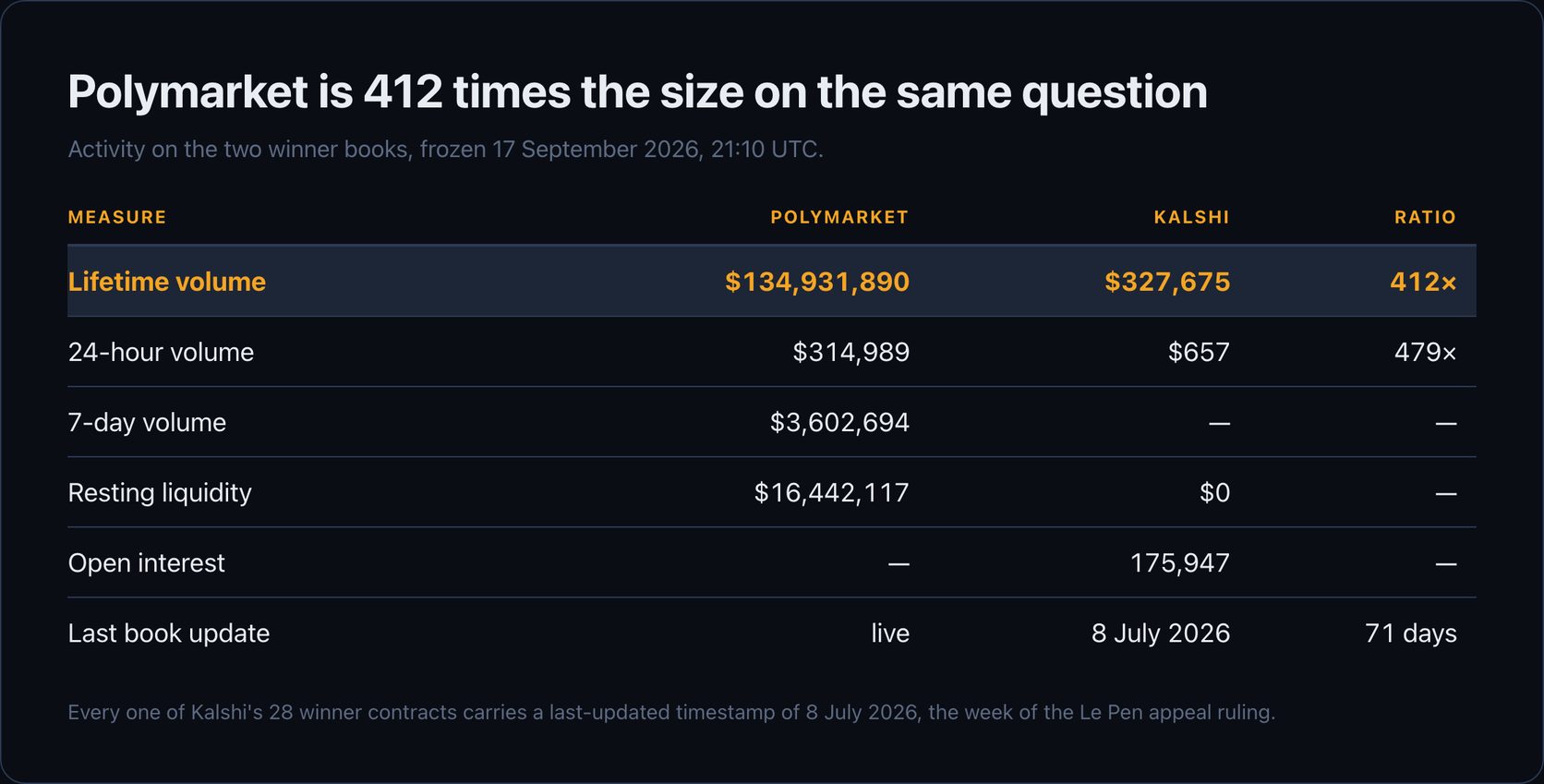
- Polymarket is 412 times the size on the same question. $134.9m lifetime against $327,675, and $314,989 in 24 hours against $657. Kalshi shows no resting liquidity on any French contract.
- Le Pen’s 36¢ is not her 33% poll number. The first round is close to settled at 87.50¢. The presidency needs a runoff win, and she lost the last one 58.55% to 41.45%.
Two exchanges list the same French election odds on the same four questions, and almost nobody puts them side by side. $134.9m sits on Polymarket’s winner market — the largest international election book it runs — while Kalshi quotes the identical contract 5 points higher off a trade nobody has refreshed since July. We pulled all four matched market pairs from both public APIs, read the resolution text of each, divided the three Le Pen contracts into each other to extract the conditional probabilities, and checked the result against every poll published since August. The finding is not that one exchange is wrong. It is that the two books agree almost exactly on whether Le Pen gets to the runoff and disagree by 7.6 points on whether she wins it — and only one of them is still trading.

Where the French election odds stand tonight
Here is the whole board on one card. Polymarket’s price is the Yes side in cents; Kalshi gets three columns because its last trade and its live quote are not the same thing, and on a book this quiet the difference matters. The midpoint is the fairest single number to compare against Polymarket, so that is the one the gap column uses.
| Candidate | Polymarket | Kalshi last | Kalshi bid/ask | Gap vs mid |
|---|---|---|---|---|
| Marine Le Pen | 36.05¢ | 41.00¢ | 38 / 40¢ | −2.95 |
| Édouard Philippe | 24.50¢ | 27.00¢ | 26 / 27¢ | −2.00 |
| Jean-Luc Mélenchon | 12.50¢ | 12.00¢ | 11 / 13¢ | +0.50 |
| David Lisnard | 7.25¢ | 9.60¢ | 8.1 / 9.6¢ | −1.60 |
| François Hollande | 5.05¢ | 5.00¢ | 4 / 6¢ | +0.05 |
| Gabriel Attal | 2.25¢ | 1.90¢ | 1.1 / 1.9¢ | +0.75 |
| Jordan Bardella | 2.15¢ | 3.90¢ | 3.1 / 3.9¢ | −1.35 |
| Bruno Retailleau | 1.55¢ | 1.70¢ | 0.2 / 1.0¢ | +0.95 |
| Éric Zemmour | 1.25¢ | 1.90¢ | 0.2 / 1.7¢ | +0.30 |
| Sarah Knafo | 1.25¢ | 1.90¢ | 1.9 / 2.9¢ | −1.15 |
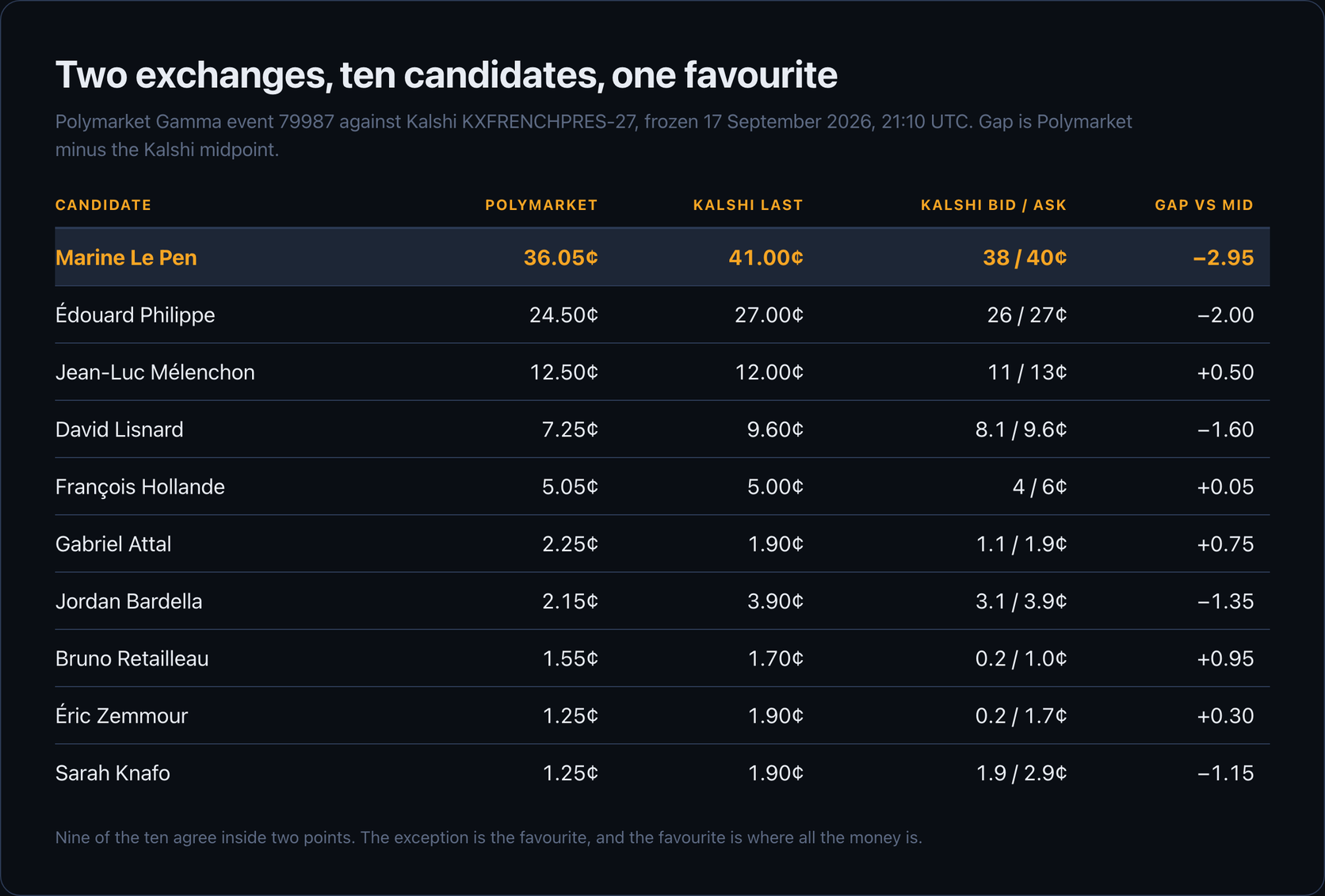
Nine of the ten agree inside two points, which for two venues with no shared traders and no arbitrage path between them is genuinely close. The exception is the favourite, and the favourite is where all the money is. That is the thread worth pulling.
Four questions, two exchanges, one election
France votes twice. A candidate needs 500 sponsorship signatures from elected officials across at least 30 departments to make the ballot at all, then more than 50% on 18 April 2027 to win outright, and failing that a place in the top two and a win on 2 May. Both exchanges have decomposed the election along exactly those seams, and listed the same four markets.
| Question | Polymarket | Kalshi | Poly volume | Kalshi volume |
|---|---|---|---|---|
| Wins the presidency | 128 contracts | 28 contracts | $134.93m | $327,675 |
| On the official ballot | 46 contracts | 22 contracts | $402,521 | $17,199 |
| Advances to round two | 37 contracts | 13 contracts | $185,356 | $1,544 |
| Socialist Party nominee | 49 contracts | 7 contracts | $50,264 | $15,906 |
The structures are the same and the scale is not. Polymarket carries 412 times Kalshi’s lifetime volume on the headline question and 479 times its 24-hour volume. But Kalshi lists a quarter as many outcomes and writes tighter rules, and on the fourth row it is plainly the better book: its socialist primary has seven named candidates summing to 107¢, while Polymarket’s left-primary cluster still carries unnamed “Person D” through “Person P” placeholders parked at 50¢ each. Read Kalshi for the rules and Polymarket for the price.
The disagreement is only about the runoff
Three of those four markets ask about Le Pen in sequence: is she on the ballot, does she reach the runoff, does she win. Because they nest, you can divide them into each other and recover what each exchange thinks about each step on its own — which is where a 5-point gap on the headline turns out to be a 7.6-point gap on one specific question.
| Step | Polymarket | Kalshi | Difference |
|---|---|---|---|
| On the official ballot | 89.00¢ | 86.00¢ | +3.00 |
| Advances to round two | 87.50¢ | 84.00¢ | +3.50 |
| Wins the presidency | 36.05¢ | 41.00¢ | −4.95 |
| Implied: advances if on ballot | 98.3% | 97.7% | +0.6 |
| Implied: wins if she advances | 41.2% | 48.8% | −7.6 |
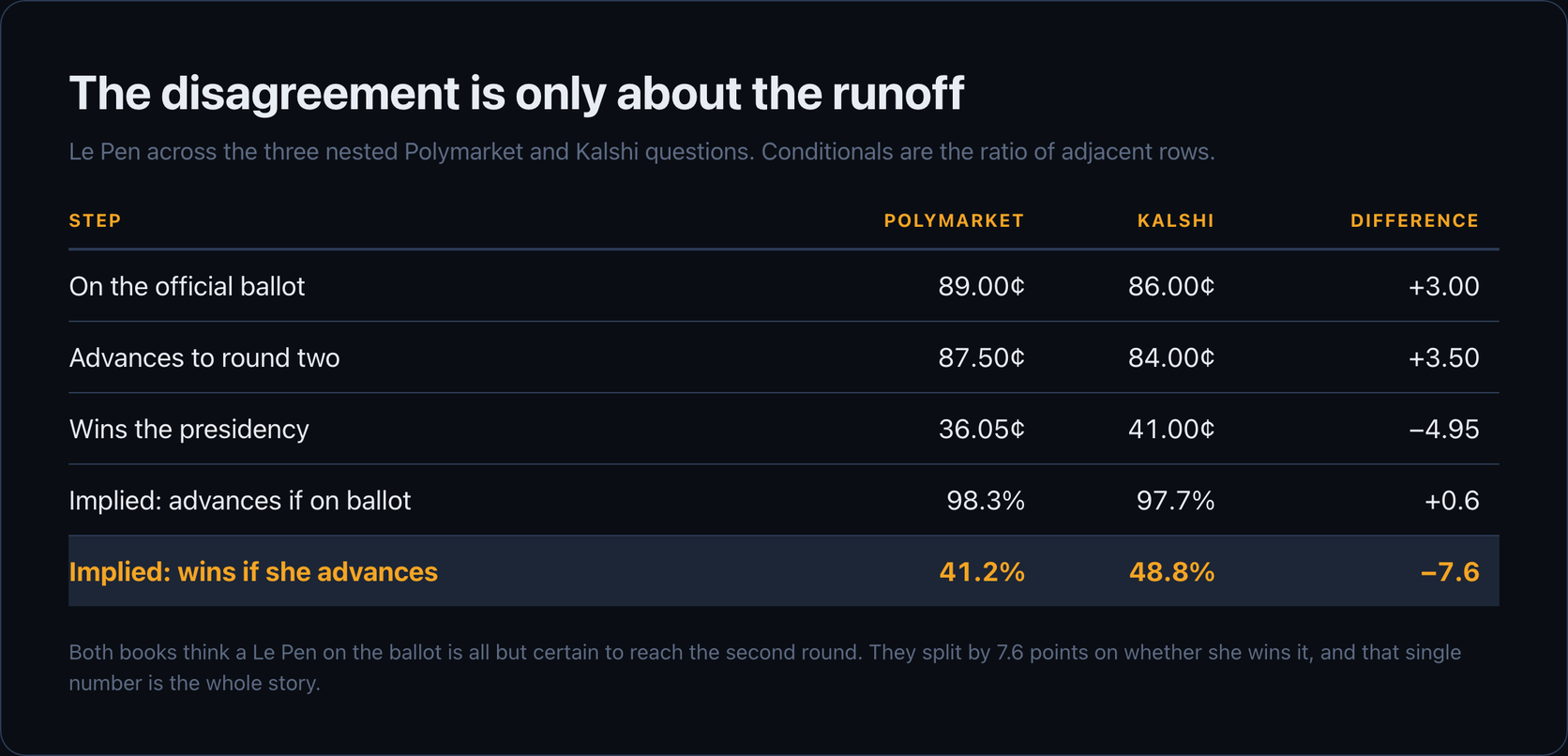
The first four rows are agreement. Both books think that if Le Pen is on the ballot she is all but certain to make the second round — 98.3% and 97.7%, a difference well inside the noise of a market with no resting liquidity. Both think there is real but modest risk she never gets there.
The last row is the disagreement, and it is the only one. Polymarket is pricing a Le Pen runoff as a 41.2% proposition; Kalshi is pricing it almost as a coin flip. Everything else on the card is an echo of that single number. When two independent books agree on the path and split on the destination, the destination is where the interesting information is — and as the next two sections show, one of those two numbers has a date problem.
What 89¢ says about Le Pen’s eligibility
The reason a ballot-access market exists on a four-time candidate at all is a criminal conviction. Le Pen was convicted in March 2025 over the misuse of European Parliament funds and handed a five-year ban on holding elected office, which would have ended her 2027 campaign before it started. On 7 July 2026 the Paris Court of Appeal upheld the conviction and cut the ban to 45 months with 30 suspended — roughly 15 months effective, backdated — alongside a three-year prison term with two years suspended and one year under electronic monitoring at home.
She declared the same day that there was no longer any scenario in which she could not run, and said she would appeal again to the Cour de cassation. The exchanges do not quite believe the first half of that: Polymarket holds her at 89.00¢ to appear on the official candidate list and Kalshi at 86.00¢, leaving 11 to 14 points for something going wrong before the Conseil constitutionnel publishes the list in spring 2027.
Kalshi’s French book stopped moving on 8 July
Every Kalshi contract carries a last-updated timestamp. On the winner market every one of the 28 reads 8 July 2026; on the other three events they all read 10 July. That is 71 days before this snapshot, and it lands in the same week as the appeal ruling. Kalshi’s 41¢ is not a September opinion about Le Pen — it is a July opinion, formed in the days when the court had just reopened her path, and left where it was.
| Measure | Polymarket | Kalshi | Ratio |
|---|---|---|---|
| Lifetime volume | $134,931,890 | $327,675 | 412× |
| 24-hour volume | $314,989 | $657 | 479× |
| 7-day volume | $3,602,694 | — | — |
| Resting liquidity | $16,442,117 | $0 | — |
| Open interest | — | 175,947 | — |
| Last book update | live | 8 July 2026 | 71 days |
Zero resting liquidity is the line that matters. Kalshi’s quotes exist, but there is nothing behind them: the 38–40¢ on Le Pen sits on a market where the last print is ten weeks old and $657 changed hands yesterday across the entire event. Treat it as a record of what someone thought in July, not a competing forecast. Polymarket’s $16.4m of resting depth is doing the price discovery here.
Why Kalshi’s card adds up to 133¢
A coherent multi-outcome book sums to about 100¢ — every candidate’s probability, added up, is the probability that somebody wins. Add up Kalshi’s 28 last-traded prices and you get 132.90¢, which would be a 33-point arbitrage if any of those prices were live. They are not, and the spread between the three ways of summing the same book is a decent measure of how stale it has gone.
| Book | Contracts | Sum | Overround |
|---|---|---|---|
| Polymarket, live prices | 128 | 99.30¢ | −0.70 |
| Kalshi, bid side | 28 | 97.10¢ | −2.90 |
| Kalshi, midpoints | 28 | 108.90¢ | +8.90 |
| Kalshi, last traded | 28 | 132.90¢ | +32.90 |
| Kalshi, ask side | 28 | 120.70¢ | +20.70 |
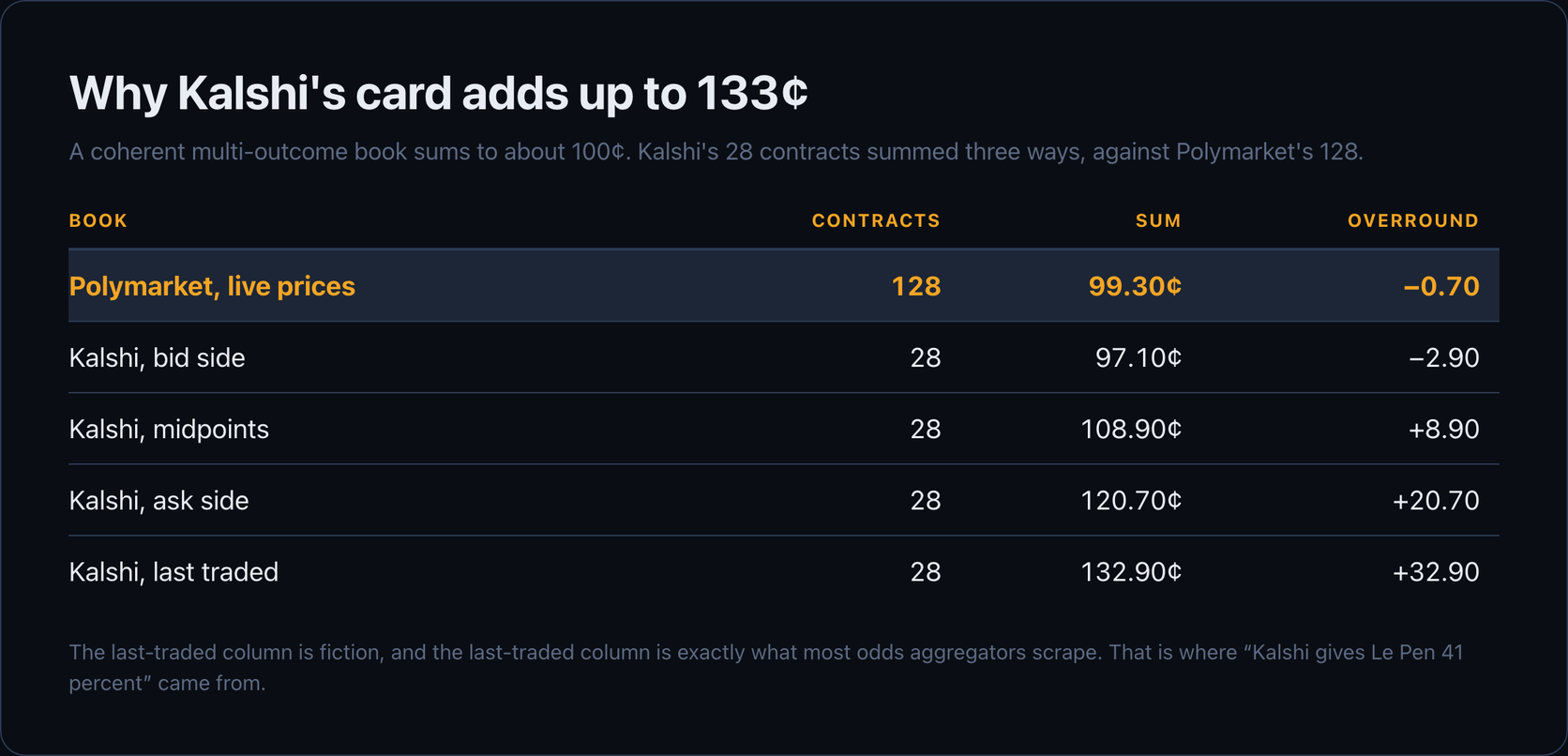
Polymarket’s 99.30¢ across 128 outcomes is the signature of a book somebody is arbitraging daily. Kalshi’s bid side at 97.10¢ is respectable too — the bids are real orders, even if thin. It is the last-traded column that is fiction, and the last-traded column is exactly what most odds aggregators scrape. If you have seen “Kalshi gives Le Pen 41%” quoted this month, that is where it came from.
What the polls say, and why 36¢ is not 33%
The most common mistake made with this market is reading the winner price as a first-round poll number. They are not the same event, and the gap between them is the entire structure of the French system.
| Pollster | Dates | Le Pen | Mélenchon | Philippe | Attal |
|---|---|---|---|---|---|
| OpinionWay | 9–10 Sep 2026 | 32% | 16% | 16% | 8% |
| Harris Interactive | 8–10 Sep 2026 | 33–36% | 16–17% | 9–14% | 14–19% |
| Ifop | 24–25 Aug 2026 | 33–35% | 17–19% | 14–18% | 15–21% |
| 2022 result | 10 Apr 2022 | 23.15% | 21.95% | — | — |
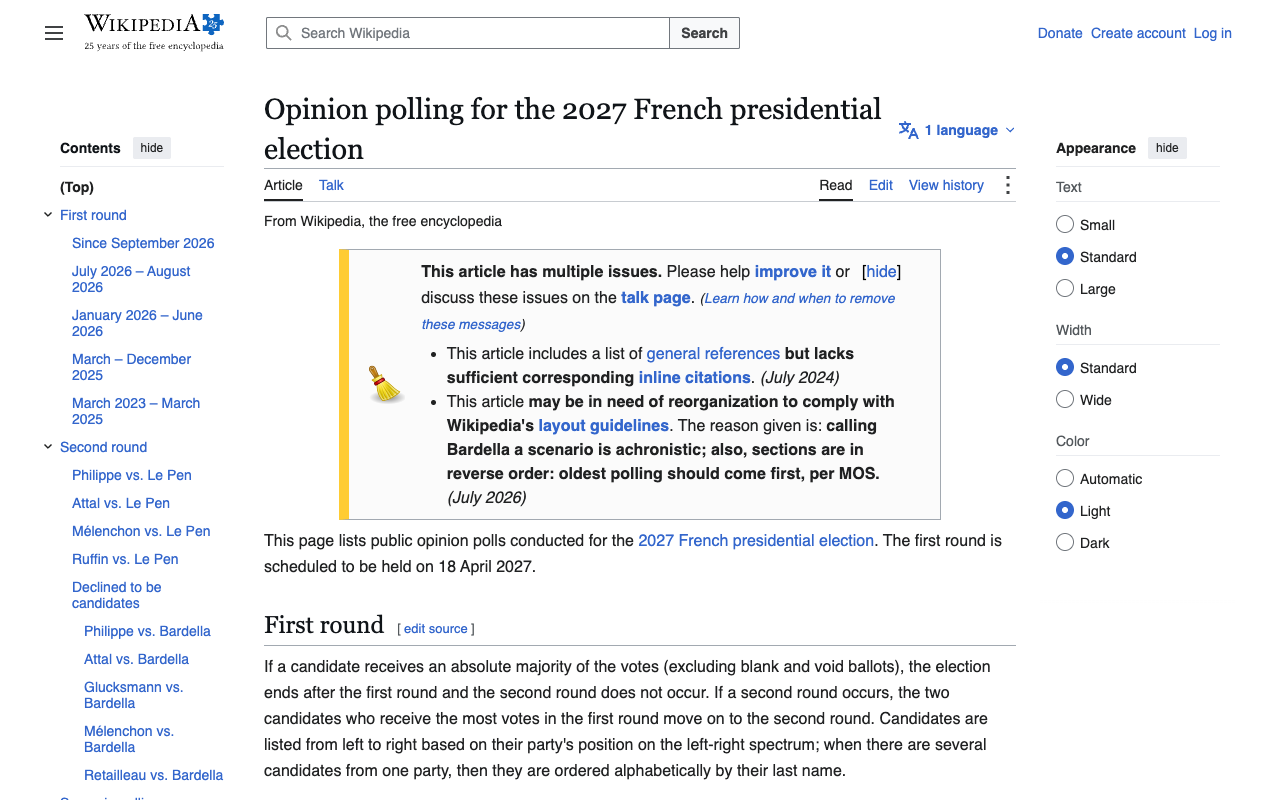
Le Pen is polling in the low-to-mid thirties, ten points clear of the field and a full ten points above her own 2022 first-round result. That is what the round-two qualification market at 87.50¢ is pricing, and on these numbers 87.50¢ looks about right — possibly cheap. Finishing top two on 33% when the opposition is split four ways is not a hard task.
Winning is. The runoff collapses that split field into one opponent, and the French second round has historically been where the National Rally vote stops growing. A 36¢ price is not a forecast that Le Pen gets 36% of the vote — it is 87.50¢ of “she makes the final” multiplied by 41.2% of “she wins it”, and the second number is the one worth arguing about.
Philippe is where the two books really split
Run the same division on Édouard Philippe and the exchanges diverge far more violently than they do on Le Pen — by twenty points, on the same conditional question. It is the clearest evidence that Kalshi’s card is internally consistent only by accident.
| Candidate | Advances (P) | Advances (K) | Wins if advances (P) | Wins if advances (K) |
|---|---|---|---|---|
| Marine Le Pen | 87.50¢ | 84.00¢ | 41.2% | 48.8% |
| Édouard Philippe | 48.00¢ | 38.00¢ | 51.0% | 71.1% |
| Jean-Luc Mélenchon | 41.50¢ | 36.00¢ | 30.1% | 33.3% |
Kalshi has Philippe winning 71.1% of the runoffs he reaches. Polymarket has him at 51.0%. Both cannot be right, and the reason for the gap is mechanical rather than analytical: Kalshi’s qualification market has taken $1,544 in its entire life, across 13 contracts, and Philippe’s leg of it last printed in July. Divide a stale 27¢ by a staler 38¢ and you get a number that means very little.
Polymarket’s 51.0% has a defensible story behind it. Harris Interactive’s July 2026 runoff test had Le Pen edging Philippe 51 to 49, and leading Gabriel Attal 55–45. A Philippe who is a coin flip in the final, and only 48¢ to reach it, is worth about 24.50¢ — which is exactly what Polymarket shows.
What moved in the last 30 days
Only Polymarket has a month of history to diff, which is itself the point. Pull the CLOB series back to mid-August and the direction is a centre-right reshuffle underneath a stable favourite.
| Candidate | 18 Aug | 10 Sep | 17 Sep | 30-day |
|---|---|---|---|---|
| Marine Le Pen | 33.40¢ | 37.75¢ | 36.05¢ | +2.65 |
| David Lisnard | 3.95¢ | 5.85¢ | 7.25¢ | +3.30 |
| François Hollande | 3.65¢ | 2.85¢ | 5.05¢ | +1.40 |
| Éric Zemmour | 0.75¢ | 0.40¢ | 1.25¢ | +0.50 |
| Raphaël Glucksmann | 1.65¢ | 1.70¢ | 1.85¢ | +0.20 |
| Jordan Bardella | 2.35¢ | 2.05¢ | 2.15¢ | −0.20 |
| Bruno Retailleau | 1.85¢ | 1.25¢ | 1.55¢ | −0.30 |
| Sarah Knafo | 1.85¢ | 0.95¢ | 1.25¢ | −0.60 |
| Édouard Philippe | 25.50¢ | 29.50¢ | 24.50¢ | −1.00 |
| Jean-Luc Mélenchon | 13.50¢ | 11.50¢ | 12.50¢ | −1.00 |
| Gabriel Attal | 3.75¢ | 1.35¢ | 2.25¢ | −1.50 |
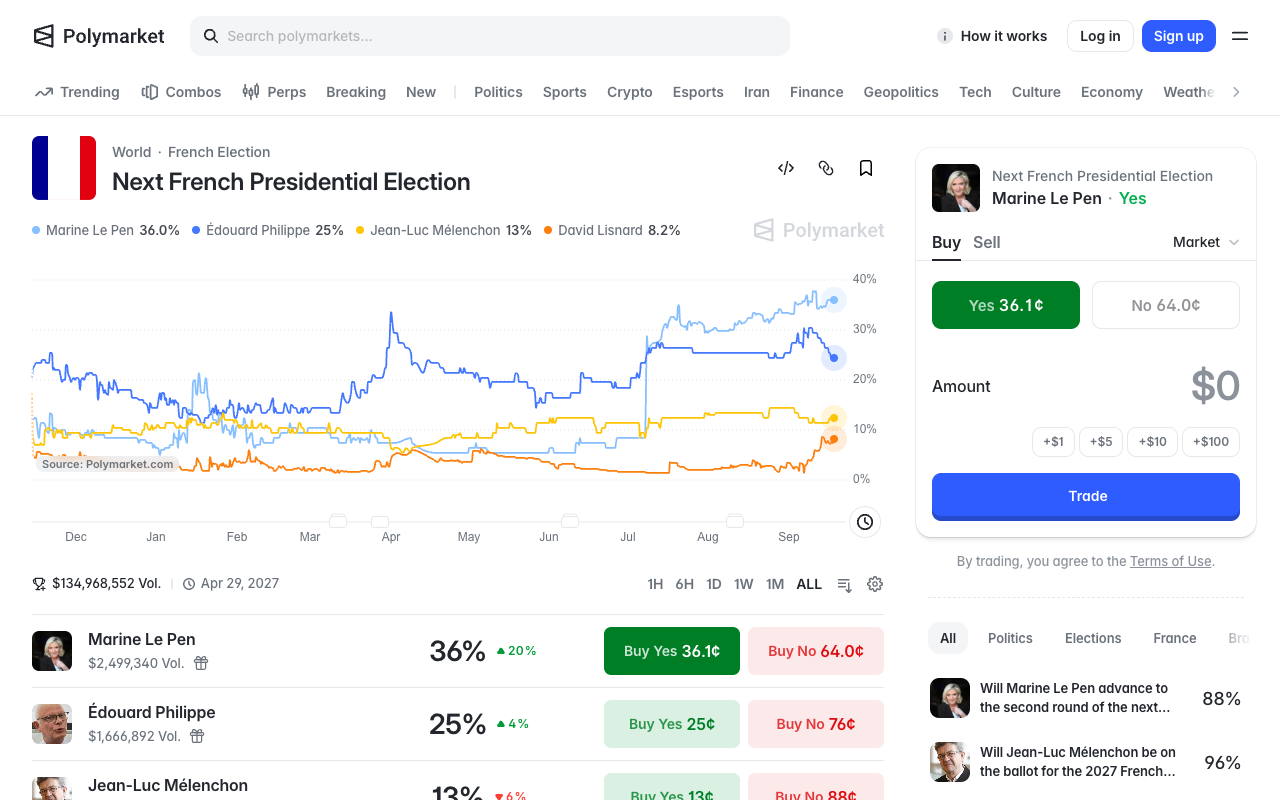
David Lisnard is the month’s biggest relative mover, nearly doubling from 3.95¢ to 7.25¢. He is the mayor of Cannes, he quit Les Républicains on 31 March 2026 to launch his own Nouvelle Énergie movement and a presidential bid, and he polls 2–3%. A candidate on 2–3% trading at 7.25¢ to win outright is the market betting the fragmented right has to consolidate behind someone and he could be that someone — the mirror image of Philippe’s 5-point slide from his 29.50¢ peak on 10 September.
What to watch before 18 April 2027
Two hundred and thirteen days out, three dated events will move these prices more than any poll. The Cour de cassation taking or refusing Le Pen’s appeal is the largest: it is the only thing that can put the 89¢ ballot contract back in play, and through it the whole card. The Socialist primary, expected in October 2026, resolves the fourth market and tells you whether the left arrives in April with one candidate or three. And the 500-signature filing window in early 2027 is when ballot access stops being a probability and becomes a list.
Related on GeoOdds
- Next French presidential election — live odds on the $134.9m winner market
- Who advances to round two — live qualification odds
- Who will be on the ballot — live eligibility odds
- Lecornu out as French PM — live odds
- Polymarket vs Kalshi: Venezuela leader odds — the same method, applied where both books trade
- Brazil election odds 2026 — the other election two markets disagree about
- Israel election odds 2026 — who replaces Netanyahu
New to prediction markets?
New traders get a $20 bonus
Deposit $10 on Polymarket and get a $20 trading bonus to put behind your first call.
See the French election markets on Polymarket →New Polymarket users only. Bonus is trading credit, expires 30 days after it lands, and terms are set by Polymarket — check the current offer at signup. 18+. Fee-free markets. GeoOdds earns a commission on signups through this link.
Frequently asked questions
When is the 2027 French presidential election?
The first round is scheduled for 18 April 2027 and the runoff for 2 May 2027. France elects its president by a two-round system: a candidate needs more than 50% in the first round to win outright, and if nobody clears that bar the top two go to a second round two weeks later. As of 17 September 2026 the first round is 213 days away.
Who is the favourite in the 2027 French presidential election odds?
Marine Le Pen, on both exchanges. Polymarket priced her at 36.05¢ on 17 September 2026 and Kalshi's last trade was 41.00¢ with a 38–40¢ quote. Édouard Philippe is second at 24.50¢ on Polymarket and 27.00¢ on Kalshi, and Jean-Luc Mélenchon third at 12.50¢ and 12.00¢ respectively.
Do Polymarket and Kalshi disagree about the French election?
On who reaches the runoff, barely. Both give Le Pen a high-80s chance of appearing on the ballot and a mid-80s chance of qualifying for the second round, within about three points of each other. The disagreement is concentrated in the final step: Polymarket implies a 41.2% chance she wins a runoff she reaches, Kalshi implies 48.8%. That 7.6-point gap is the whole story.
Is Marine Le Pen eligible to run for president in 2027?
On the current ruling, yes. The Paris Court of Appeal upheld her embezzlement conviction on 7 July 2026 but cut the ban on holding elected office to 45 months with 30 suspended, leaving roughly 15 months effective and backdated, which reopens a path to 2027. She said she would run and would appeal again to the Cour de cassation. Both exchanges still price residual risk: Polymarket has her at 89.00¢ to make the official ballot, Kalshi at 86.00¢.
Why is Le Pen only 36¢ to win when she polls 33% in the first round?
Because the market resolves on the presidency, not the first round, and those are different events. Leading the first round on 32–36% is close to priced-in — Polymarket gives her 87.50¢ to reach the runoff. Winning the runoff means beating one consolidated opponent, which she has never done. In 2022 she lost the second round to Emmanuel Macron 58.55% to 41.45%.
How much money is on the French presidential election?
Polymarket's winner market had taken $134.9m in lifetime volume by 17 September 2026, with $16.4m of resting liquidity and $314,989 traded in the previous 24 hours. Kalshi's equivalent event had $327,675 lifetime and $657 in 24 hours. Polymarket's book is roughly 412 times larger on lifetime volume and 479 times larger on the day.
Why do Kalshi's French election prices add up to more than 100%?
Because they are last-traded prices, and most of those trades are from early July 2026. Summed across the 28 named contracts, Kalshi's last prices total 132.90¢. The live quotes are much more sensible: the bid side sums to 97.10¢ and the midpoints to 108.90¢. Polymarket's 128-contract book, which trades every day, sums to 99.30¢.
Which exchange should I use for French election odds?
For a current price, Polymarket — its book is arbitraged daily and its quotes are minutes old rather than weeks. Kalshi's value here is structural rather than numerical: it lists the same four questions with tighter written resolution rules, and its socialist-primary book is cleaner than Polymarket's, which still carries unnamed placeholder outcomes. Read Kalshi for the rules and Polymarket for the price.
Sources: Polymarket Gamma and CLOB public APIs (events 79987, 407284, 531333, 700777); the Kalshi public markets API (events KXFRENCHPRES-27, KXFRPRESBALLOT-27JUN30, KXFRPRESADVANCE-26APR18, KXFRPSNOM-26OCT01); Wikipedia on the electoral system, the election dates and the sponsorship requirement, and its campaign polling compilation; Al Jazeera on the 7 July 2026 Court of Appeal ruling; and the Conseil constitutionnel, which publishes the official candidate list both ballot markets resolve against. Prices captured 17 September 2026, 21:10 UTC and not updated since. Nothing here is investment advice — see our disclaimer.